Many migrants are struggling to access remote HIV tests – but we can work together to help them

Published 1st December 2020

Mimi Mzari is the HIV Project Lead at Doctors of the World UK. She has been working to improve access to HIV testing and information for migrants and refugees, a group often excluded from healthcare due to the hostile environment.

On World AIDS Day, Mimi reflects on the challenges and opportunities COVID-19 has created for healthcare practitioners, patients and global efforts to eliminate HIV.

Much about the year 2020 has been far from “normal”. Across the world, we have been fighting the Covid-19 pandemic, monitoring symptoms, social distancing, wearing face coverings and surviving lockdowns.

For most of us in the UK with access to healthcare, we know that if we experience symptoms of illness, medical help is available to us through the NHS, but what about those who don’t have good access to healthcare?  

As the Doctors of the World UK (DOTW) HIV project lead, my aim is to improve access to HIV testing and information for migrants and refugees, a group often excluded from healthcare due to this and previous governments’ eagerness to create a hostile environment for migrants.

Doctors of the World UK HIV Project Lead, Mimi Mzari.

One of the many challenges of my role has been working out how to provide HIV point of care tests (POCT) remotely to people who are trying to navigate a new healthcare system and adapt to a new country and way of life.

Point of care tests provide results within minutes, which is great for patients who don’t have time to wait for long and ideal for professionals like myself to instantly follow up if someone needs further care. Knowing your HIV status early is important because it reduces mortality and prevents further HIV transmission.

Before the pandemic, people were able to walk into our volunteer staffed clinic in east London and receive a health assessment and support to access NHS services such as registering with a GP, dental care and antenatal care.

In that setting, we were able to offer HIV point of care tests to anyone who walked in with results in a matter of minutes. Upon getting their result, we would provide them with sexual health advice and support and link them into further care if needed.

A patient is seen at Doctors of the World’s drop-in clinic in London. Our volunteer doctors, nurses and support workers offer health assessments and advice to excluded people, including asylum seekers and undocumented migrants.

Adapting our services to function remotely in a short space of time has changed how people engage with our services. It has both advantages and disadvantages, on the one hand, it means we do not put service users at risk of Covid-19 and people do not have to travel far to reach our clinic. On the other hand, it means only those who have access to the internet or a phone can contact us for support. 

Digital exclusion – something that has become more apparent during the pandemic – at a time when almost everything is online and remote really challenges us as practitioners to get creative in the way we deliver vital healthcare services such as HIV testing.

The way we access healthcare and other services has changed for everyone in the UK, but even more so for migrants, refugees, asylum seekers and sex workers, who are among the most marginalised groups in our communities.
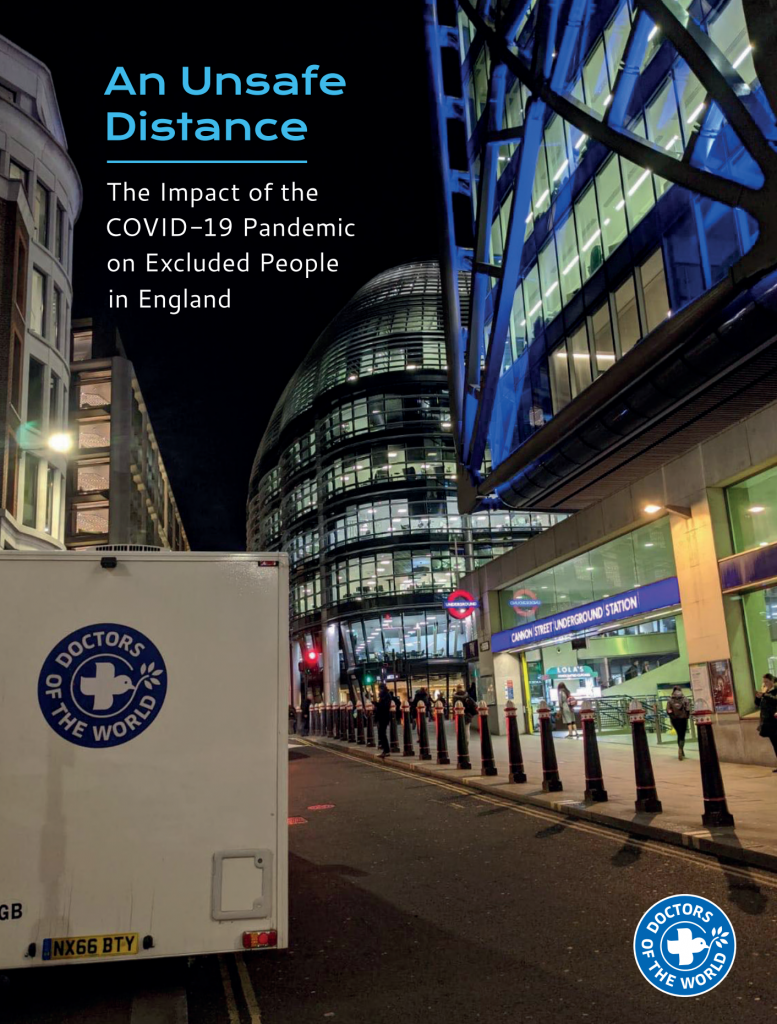
This briefing highlights the key themes identified in the Rapids Needs Assessment.

Research carried out by DOTW at the height of the first wave found the shift to remote healthcare services had failed to account for the digital exclusion experienced by people in vulnerable circumstances.

Many do not have the device, credit/data, internet access, or digital literacy required for access. Remote consultations also pose a challenge for people whose first language is not English or who are unable to articulate their symptoms well enough for an accurate medical assessment to be made remotely.

I am the child of a refugee, which means I am all too familiar with some of these challenges. My work at DOTW is driven by my awareness of the complexities of the migrant and refugee experience, and my passion to tackle HIV in compassionate, innovative and inclusive ways.

However, even I have been guilty of underestimating the challenges excluded groups, such as refugees, face and how these affect the way individuals engage with healthcare services, let alone testing a highly stigmatised disease such as HIV.  

My time at DOTW has required me to think about how we can deliver a remote HIV testing service during this pandemic. We are rethinking and reflecting on the role language and other factors, such as fear of arrest as a result of immigration status, play in contributing to the poor health and wellbeing of migrants and refugees in the UK.  

While we have been implementing our remote HIV testing service, we have been signposting people to NHS services such as Sexual Health for London and Sexual Health 24. They offer a fantastic free service where people can order discreet STI home testing kits and receive their results in a few days.

We have been able to support service users for whom English is a first language to order their kits online to an address of their choosing. But inevitably some people fall through the cracks. The continuous task, therefore, is to come up with innovative ways to reach the people and communities who need our services the most.

This year, the theme for World Aids Day is “Global solidarity, shared responsibility” in pursuit of the 90-90-90 target, which aims for 90 per cent of people living with HIV to know their status, 90 per cent of people diagnosed with HIV to be on treatment, and 90 per cent of people receiving treatment to have an undetectable viral load – meaning they can’t pass the virus onto others.

These targets are possible if all the sectors involved in the fight against HIV work collaboratively to achieve this goal and overcome barriers to healthcare such as digital exclusion.  

Covid-19 has presented many challenges, but it has also given us the opportunity to try doing things differently, to be creative and inclusive in the services we provide to ensure we achieve this goal.

About Mimi

Mimi holds a BSc in Anthropology (Brunel University) and a MSc International Development (University of Amsterdam). She has five years’ experience in the HIV and sexual and reproductive health and rights sector, and has worked with a diverse range of service users and partner organisations, both in the UK and internationally, to implement culturally and socially specific testing outreach activities.

This article originally appeared in The Independent.

Born in exile

Published 27th November 2020

Doctors of the World (DOTW) is delivering vital medical care and humanitarian aid on the Greek island of Lesvos, where thousands of vulnerable men, women, and children live in refugee camps. Earlier this month, our team was called to a medical emergency…

There were dramatic scenes on Lesvos as a woman started going into labour in the new refugee camp built in the wake of September’s wildfires.

The medical facilities in the camp are far from sophisticated but as the umbilical cord was wrapped around the baby, there was no time to wait for an ambulance to take the mother to the hospital.

Fortunately, our highly trained and experienced medical staff were on hand, and gynaecologist Erminia Dalakli (pictured) leapt into action, helping the mother safely deliver this beautiful baby girl.

DOTW gynaecologist Erminia helped to deliver this baby girl in the new refugee camp on Lesvos. Photo: Médecins du Monde Greece

Erminia explained she didn’t have a minute to waste when the baby was about to make her entrance: “The mother’s dilation was perfect. We called an ambulance from the National Center for Emergency Assistance in order for her to be transferred to the hospital, but I had noticed that there were many umbilical cord wraps, so she had to give birth right there.

“But it was OK, I have delivered many babies before.”

The baby was born weighing a healthy 3100 grams, with a shock of dark hair and rosebud lips. She doesn’t have a name yet, but she has no shortage of admirers.

Europe’s shame

It is an absolute tragedy and a disgrace that any child should be born in a refugee camp in Europe. But thankfully our expert staff were able to ensure the safe delivery of this little girl and make the best of what is a terrible situation.

The inevitable sense of hope and happiness that comes with new life has spread throughout the camp. Help us continue to ensure life-saving medical care is available for mothers in need by donating now.

The Moria refugee camp hosted over 12,000 migrants and asylum seekers, who fled with as many possessions they could carry as the camp burned to the ground.

It’s been 10 weeks since Moria refugee camp burned to the ground and more than 12,000 men, women and children were left homeless.

The Greek authorities have responded by building another camp, with the capacity to hold over 10,000 people, at a former military shooting range on the island, once again giving Lesvos the unenviable title of hosting Europe’s largest refugee camp.   

The camp may be new but the situation facing the thousands of migrants and refugees trapped on the island remains desperate.

They continue to live in cramped and overcrowded conditions with unreliable electricity and water supply, poor access to healthcare and the threat COVID-19 ever present, as cases spike countrywide

How we’re responding

DOTW has been working on Lesvos since 2014 and was one of the first NGOs to enter the new camp, working quickly to screen for COVID-19, perform urgent health assessments, and refer the most complicated cases to health services on the island.

However, the local health system has its own limitations exacerbated by Greece’s socioeconomic crisis and Europe’s reception crisis. As well as being responsible for meeting the health needs of 3000 people spread across two residential zones in the new camp, we’re also providing staff and support to the Ministry of Health.

Doctors of the World has been working on Lesvos since 2014. Photo: Photo: Yiannis Yiannakopoulos

DOTW’s team on the ground provides a range of primary health services, including medical screening and diagnosis, sexual and reproductive healthcare, and distributing medication to people with chronic illnesses.

Between September 28 and November 8, we helped 1,649 people, including 384 children. Also distributed 5,000 hygiene kits and COVID-19 protection equipment.

Thanks to you

We raised an incredible £21,344 through our recent emergency appeal for Moria. This money will ensure our expert staff can continue to respond to the situation on the ground and deliver life-saving medical care seven days a week.

A family in the new refugee camp on Lesvos. Photo: Yiannis Yiannakopoulos

It’s not too late to support our work with refugees in Greece, the UK and around the world.

Just £15 could provide a family with an emergency hygiene kit, while a regular gift will help us better plan for the future, which is so important in these challenging times.

Going forward, our team on Lesvos will be focused on strengthening the resilience of the most vulnerable asylum seekers and refugees and offering a comprehensive package of primary health care services.

Press release: Doctors call for closure of military barracks housing asylum seekers amid health concerns

Published 26th November 2020

Housing asylum seekers and survivors of torture and modern slavery in military barracks during a global pandemic is clinically inappropriate and puts migrant lives and public health at risk, warn UK healthcare professionals.

They have written to the Secretary of State for the Home Office and Secretary of State for Health and Social Care to urge them to close barracks housing asylum seekers in England and Wales amid growing concern about conditions in the camps, residents’ complex health needs and poor access to healthcare, and the lack of COVID-19 measures in place.

The joint letter has been coordinated by Doctors of World, Freedom from Torture and the Helen Bamber Foundation and signed by the Royal College of Psychiatrists and Faculty of Public Health.

“As organisations representing medical professionals and patients, we are writing to raise concern about the use of Ministry of Defence (MoD) sites to house people seeking asylum and survivors of modern slavery,” they said.

“We believe that these sites are unsuitable for this purpose due to the lack of access to adequate and appropriate healthcare services, the public health risks resulting from a lack of compliance with the COVID-19 regulations, and the risk of re-traumatisation triggered by accommodation in former military barracks.

“We call for an end to the use of MoD sites as accommodation for migrants.”

In September, the government commissioned previously disused MoD sites at Penally in Pembrokeshire, Wales, and Folkstone in Kent, England, as accommodation for people who are seeking asylum in the UK. Despite being defined as contingency (temporary) accommodation, the Home Office announced that the sites will be used for 12 months, with 665 people to be accommodated across both sites.

Doctors of the World, Freedom from Torture and the Helen Bamber Foundation have been working together to provide support to residents, who would otherwise have little to no access to healthcare, despite the high prevalence of complex physical and mental health needs among the asylum seeking population.

“During a pandemic, it’s more important than ever that people can easily seek advice and care from a GP to avoid unnecessary pressure on emergency and hospital services.”

Anna Miller, Head of Policy and Advocacy, Doctors of the World UK

They have grown increasingly concerned about conditions in the camps and the health and welfare of residents, with a suicide attempt at the Kent site last week.

“We are hearing concerning reports of poor mental health among residents leading to suicide attempts, self-harm and unrest within the barracks,” said Dr Jill O’Leary, lead doctor for the Helen Bamber Foundation’s medical advisory service.

“The sudden and unexpected diversion of hundreds of new residents to the barracks with very little notice for the local health boards places them under immense strain at a time when health services
are already overburdened. Local health boards have had to work incredibly hard with no extra funding or prior consultation to try to identify and address these needs.”

Dr O’Leary said the sites also appear to be completely ill-equipped to maintain social distancing measures and adequate hygiene, posing a major public health risk.

“Residents are staying in very large, shared dormitories, with shared bathrooms and washing facilities. They have been moved in from all around the country and we have reason to believe many have not been able to self-isolate prior to their arrival,” she said.

Anna Miller, Head of Policy and Advocacy at Doctors of the World UK, said: “It is outrageous and irresponsible that in the middle of pandemic, when the British public is making great sacrifices to stop the spread of COVID-19, the Home Office has decided to move people across the country from safe accommodation where they could socially distance and isolate when needed, into shared dormitories.

“We are also concerned that the 600 plus people accommodated in these barracks can’t register with a GP and are largely reliant on first aid and paramedic call outs. GPs play an essential role in managing everyday conditions and regular medications, picking up health problems early and keeping people out of hospital. During a pandemic, it’s more important than ever that people can easily seek advice and care from a GP to avoid unnecessary pressure on emergency and hospital services.”

“People who have survived such horrors deserve compassionate, trauma-informed care by experienced practitioners.”

Dr Jill O’Leary, lead doctor for the Helen Bamber Foundation’s medical advisory service

Dr O’Leary, along with other concerned clinicians and lawyers from Doctors of the World, Freedom from Torture, the Helen Bamber Foundation and Forrest Medico-Legal Services, has been meeting remotely with local volunteers. They aim to enhance health and vulnerability screening assessments for residents to identify individuals who are most at risk of the deleterious effects of living in the barracks.

“I assessed a young man from Yemen who had been imprisoned and tortured by the state. He travelled from Yemen across Europe before arriving in the UK to seek asylum,” said Dr O’Leary.

“His solicitor contacted me due to concerns about his deteriorating mental health since being moved to the barracks. The military environment causes him to experience flashbacks to his time spent in prison and he suffered insomnia as well as severe anxiety as a consequence.

“He had physical health needs that were not being met in this accommodation including lack of access to pain relief as he suffered chronic pain as a result of his torture. It was clear that his mental and physical health were deteriorating rapidly due to being in the barracks and he was thankfully relocated once a letter of clinical concern had been written.”

Dr O’Leary, who has a background in working with refugees in the Moria refugee camp in Greece and Za’atari refugee camp in Jordan, said while she was able to help this man get the care and support he needed, she was extremely concerned about those who remained in the camps and the impact that this lack of adequate healthcare would have on their wellbeing.

“Many residents may be victims of trafficking or torture. They may be fleeing persecution or conflict in their home countries and are likely to have endured a horrific journey to reach the UK,” she said.

“People who have survived such horrors deserve compassionate, trauma-informed care by experienced practitioners. We are concerned that these issues are not being identified and the level of healthcare provided is not adequate to address such complex needs.”

“The mark of a civilised society is how it treats its most vulnerable members, this government should be ashamed it is failing so badly.”

Dr Juliet Cohen, Head of Doctors at Freedom from Torture

Dr Juliet Cohen, Head of Doctors at Freedom from Torture, said: “The barracks are entirely unfit for survivors of torture and trauma. A prison-like environment, crowded accommodation, and lack of privacy, particularly in the bathroom, can all trigger symptoms of post-traumatic stress disorder such as increased frequency of flashbacks or nightmares of traumatic past experiences, increasing the risk of self-harm and suicide. The mark of a civilised society is how it treats its most vulnerable members, this government should be ashamed it is failing so badly.”

Today (Thursday, November 26), Jennifer Blair, Co-Head of Legal Protection at the Helen Bamber Foundation, will present the group’s concerns to the All-Party Parliamentary Group on Immigration Detention at a panel event examining the route through which the Home Office is processing people arriving by small boats across the Channel.

But they also felt the need to write directly to the Home and Health secretaries, Priti Patel and Matt Hancock.

“Healthcare professionals have a duty to protect and promote health and wellbeing,” they said. “As organisations representing healthcare professionals in the UK, we are committed to promoting equality and fundamental rights in healthcare and cannot ignore a policy that is detrimental to the health and wellbeing of those seeking sanctuary in our country.

“Given the lack of adequate health provision for those accommodated in the sites and the inappropriateness of former barracks as housing for people fleeing persecution and survivors of torture, as well as the current public health risks, we urge the government to immediately end the use of MoD sites as accommodation for migrants.”

For more information or to arrange interviews, please contact Kimberley Vlasic at KVlasic@doctorsoftheworld.org.uk.

Baby boxes: A lifeline for vulnerable mums

Published 30th October 2020

Can you imagine having to choose between eating dinner or buying nappies for your baby? This is the harsh reality facing many of Doctors of the World’s (DOTW) pregnant patients, who are among the most marginalised women in the country.

“So many of our pregnant service users experience extreme hardship and have to make stark choices between such things as having an evening meal or buying nappies or a sleep suit for the baby,” said Bettina, a midwife and long-time DOTW volunteer.

Bettina and her colleagues at the Women and Children’s Clinic support hundreds of women and their families each year, offering health checks and information and advice on accessing NHS services and what to do if they receive a bill for their NHS care.

Now, thanks to a new partnership with PramDepot, an arts-led recycling project, we hope to make vulnerable mums’ lives a little easier by providing many of the things they need to welcome a new baby into their home.

Introducing the baby box.

Contactless delivery: PramDepot has been delivering baby boxes to vulnerable mums and mums to be around London throughout COVID-19. Photo courtesy of PramDepot

Baby boxes contain high quality recycled baby clothes and equipment, which are assembled at PramDepot’s London premises and delivered directly to the mother’s door by PramDepot volunteers.

“It has a fitted mattress and sheet so the baby can sleep in the box… Inside are all of the baby items that the mum needs – nappies, wet wipes, breast pads and all that stuff. It’s got a breast pump and steriliser, milk storage bags, a sling,” said PramDepot founder Karen Whiteread.

An equal start to life

Baby boxes are commonplace in Scandinavian countries, such as a Finland, where the tradition dates back to the 1930s. In Finland, a government-funded maternity package is available to all expectant mothers to give all children, no matter what background they’re from, an equal start to life.

Baby boxes are also provided universally in Scotland and supported by the Royal College of Midwives as a way to reduce the risks associated with unsafe co-sleeping. The baby box is designed so that the baby has its own bed!

What’s inside: Baby boxes contain essential baby items, including a mattress so that the box can be turned into a bed for the baby. Photo courtesy of PramDepot

Karen explained how the baby boxes and PramDepot came about.

“It started as an art project because I’m an artist and I started volunteering as a birth companion to support women who don’t have anyone to be with them when they’re in labour,” she said. “There were about 30 of us spread all over London and we all had stuff that people had donated to us and it was proving to be really difficult to coordinate getting the items to the women.”

A trip to an art exhibition inspired Karen to transform her studio into a storage space for the donated items as “an ever-changing art installation” and PramDepot was born.

PramDepot has been running for seven years and previously gave baby clothes and equipment to vulnerable mums. Then COVID-19 forced Karen to rethink service delivery. She launched the baby box initiative during lockdown to ensure women in extremely vulnerable situations can still get support in a safe way.

Helping the most vulnerable

If a DOTW patient is identified as extremely vulnerable or as having no financial support, they are referred to PramDepot, which arranges delivery of a baby box.

“We only support women who aren’t supported by anyone else or have serious mental health or domestic violence issues… we’re trying to fill a gap,” said Karen. “DOTW is an organisation that supports undocumented women, who I feel are some of the most vulnerable women and obviously don’t get any other support. DOTW helps us reach the hard-to-reach women.”

As a mother of two and grandmother of one, Karen knows how important it is to have support during pregnancy and motherhood.   

“I was quite young when I had my first daughter and I lived in a commune and had very little money,” she said. “But I had other women with babies around me, we supported each other. It was a magical time and the reason it was like that is because we had support.

“When I became a birth companion, I realised that there are so many women out there with no support, without their parents down the road, without their sisters, or even women that speak their own language. It must be so hard and so difficult. I can’t imagine what it’s like.”

Delivery

To reduce the risk of COVID-19, PramDepot volunteers wear masks and gloves for deliveries, which are contactless.  

“All we’re doing is taking the lid off the box and showing them the instruction manual with all the health and safety stuff in it and telling them they mustn’t put the lid on the box when the baby is in it, which usually causes quite a laugh,” said Karen. “But you have to say it because people have done it,” she added.

For the women PramDepot supports, knowing that they have many of the things they need – as well as a place for the baby to sleep – comes as a huge relief. The delivery of a baby box has even been known to send some expectant mothers into labour!

“We’ve heard from referees that mums have gone into labour the next day,” said Karen. “Quite often it’s such a relief that they’ve got all the stuff.”

Mary

When Mary (not her real name) first came to DOTW, she was four months pregnant but wasn’t registered with a GP and hadn’t received any antenatal care. Pregnant in the middle of a pandemic and miles from her friends and family in the Philippines, she was struggling with both her physical and mental health.

Fortunately, Mary found DOTW and our staff and volunteers helped her to get the care and support she needed.

“There are not enough words to say how thankful me and my husband are,” said Mary. “For help in all aspects, especially for health. DOTW is always there, not only for vulnerable women, but also for vulnerable people, so that we have equal health rights.

“I cannot imagine what would have happened to me without DOTW, especially when I was looking for a hospital. Also, regarding my emotional stress and the problems I have experienced. I will never forget how much you have helped me and the baby. I hope you will help more people like us in the future.”

Mary is the first DOTW patient to receive a baby box kindly donated and delivered to her door by PramDepot.

“First of all, I felt overwhelmed, surprised. I was not expecting what it is,” she said. “When receiving I felt very happy. There is a lot of stuff inside which is very helpful for me and the baby.”

A two-way street

The experience is just as rewarding for the women who contribute to the baby boxes as those who receive them. Karen said most of those who donate to PramDepot are new mums, who quite often burst into tears at the thought of being on their own.

“They see the boxes or whatever it is they’ve given, and they just get overwhelmed by how privileged they feel being able to come and give stuff to PramDepot for women who haven’t got anything,” she said.

“I think that’s what’s really nice about PramDepot, it’s like the conduit between women who want to support other women but have no way of doing that as an individual but can do it as a collective. We do see a PramDepot as a community.”


If you’re interested in donating baby items or volunteering with PramDepot, please email pramdepot@mail.com. Please be aware PramDepot is a small organisation with limited resources and is currently only taking baby box referrals from partner organisations.

If you can, please consider donating to DOTW’s Women and Children’s Clinic to ensure vulnerable women and their families can access healthcare and support, such as baby boxes.

Press release: New report reveals the devastating impact of NHS charging on migrants in vulnerable circumstances

Published 14th October 2020

Migrants living in extremely vulnerable circumstances in England are waiting up to 224 weeks to receive medical care because of laws forcing hospitals to carry out immigration checks and withhold care from patients deemed not eligible for free NHS treatment – even when the patient has no income, or the upfront payment would push them into severe debt or further poverty.

A new report by Doctors of the World UK (DOTW) reveals medical care charges are being applied to those least able to pay – people who are homeless, destitute, and already struggling to meet their basic needs – as well as those with a legal barrier to removal from the UK, which means the patient cannot travel to another country to seek treatment. Read the full report here.

This is leading to lengthy treatment delays for migrants already living in extremely vulnerable circumstances, including those with life-threatening or serious health conditions who are having ‘immediately necessary’ or ‘urgent’ NHS services withheld for months and, in some cases, years.

Titled Delays and Destitution: An Audit of Doctors of the World’s Hospital Access Project (July 2018-20), the report provides quantitative data on the NHS charging policy for the first time and sheds light on the catastrophic consequences of charging migrants for healthcare.

“The report lays bare the true impact of the NHS patient charging policy on patients. Put simply, those who cannot afford to pay have to go without treatment, however desperately they need it,” said Anna Miller, report author and DOTW’s Head of Policy and Advocacy.

“It shows that all the safeguards put in place to ensure urgent medical care is provided regardless of a person’s ability to pay aren’t working, and patients suffer for months, sometimes years, on end, alone.”

To prepare the report, DOTW carried out an audit of service user data collected by caseworkers delivering the charity’s Hospital Access Project between July 2018 and July 2020. The Hospital Access Project provides specialist casework support and legal advice to people refused NHS hospital care or non-primary care-related NHS services in the community due to their immigration status in the UK and as a result of the NHS charging regulations.

Twenty-seven DOTW service users aged four to 75 years old were involved in the audit. The majority (44.4% or 12/27) had a ‘refused asylum claim’ and 37% (10/27) of service users had an outstanding human rights or asylum application, or appeal. Nearly half (44.4% or 12/27) of service users could not be removed from the UK due to an outstanding legal case.

The audit also found: 

  • The NHS charging policy is being applied to destitute individuals with no realistic prospects of being able to pay for the NHS services they receive. Nearly all the service users (96.3%) accessing the project were destitute and unable to meet their basic needs.
  • The NHS charging policy is delaying patients’ access to NHS services. The average length of delay was 37.3 weeks from the point of diagnosis (rather than GP referral) – more than twice the NHS target time.
  • Approximately 60% (59.9%) of service users faced delays of over six months, with the longest delay recorded extending to over four years (224 weeks). Those requiring either an urgent or immediately necessary NHS service faced a delay of 36 weeks on average, with the longest delay in receiving treatment at 135 weeks or 2.5 years.
  • Urgent and immediately necessary NHS services are also being incorrectly withheld from individuals who could not reasonably be expected to leave the UK to receive treatment elsewhere. This indicates the charging policy is too complex for NHS trusts to apply correctly and many NHS trusts are failing to correctly assess when an individual can reasonably be expected to leave the UK.

Ms Miller said charging for medical care risks leaving unwell people exposed and without healthcare.

“This report shows that in the UK, medical care charges are being applied to those least able to pay – people who are homeless and destitute, people who already struggle to afford to feed themselves,” she said. “At best, the NHS charging policy is problematic, unworkable in practice, and a poor use of NHS resources. At worst, it is reckless and a threat to patient and public health, and the UK’s commitments to achieve universal healthcare coverage.”

Ms Miller said the Hospital Access Project audit adds compelling evidence to the urgent calls from the Hands Up for Our Health campaign – launched last week by DOTW, Lancet Migration and the Faculty for Public Health – for an immediate suspension of the NHS charging regulations. Over 50 organisations have joined the coalition calling for urgent investigation and reform, and improved access to all NHS services, during COVID-19 and beyond.

“During a global pandemic, we really need every person and every family to feel safe to go forward to NHS services – including COVID-19 testing services – without the risk of financial or legal consequences,” she said.

Based on the findings of the Hospital Access Project audit, DOTW makes the following recommendations to reform the healthcare entitlement policy to ensure the UK meets its commitments to achieve universal healthcare coverage and upholds its human rights obligations. These should be urgently adopted to address the issues identified in the report and to prevent unnecessary treatment delays and patient suffering.

1. Change the definition of ‘ordinarily resident’ to include all individuals living or resident in the UK regardless of immigration status.

2. Introduce an exemption for individuals on low, or no, income.

3. Establish an independent, transparent process whereby individuals can challenge the decisions made by NHS trusts under the charging regulations and resolve cases within two weeks

You can view the full report below.

The report presents the findings of an audit of service user data collected by caseworkers delivering DOTW’s Hospital Access Project.

For more information or to arrange interviews, please contact Kimberley Vlasic at KVlasic@doctorsoftheworld.org.uk.

Coalition calls for the immediate suspension of NHS charging to prevent more COVID-19 deaths over the winter

Published 6th October 2020

Charging migrants for hospital services is putting lives and public health at risk, and could undermine the UK’s COVID-19 response, warns a coalition of academics, non-governmental organisations, professional bodies and people with lived experience of healthcare exclusion.

Today, Doctors of the World UK (DOTW), Lancet Migration: global collaboration to advance migration health, and the Faculty of Public Health (FPH) are launching a coalition campaign to call for universal and equitable access to NHS services during the COVID-19 pandemic and beyond.

More than 30 organisations have already joined the Hands Up for Our Health campaign and coalition building is ongoing. Read the joint press release.

The coalition said as a first priority, the UK Government must immediately suspend the NHS charging regulations, which pose a serious risk to public health and are causing unnecessary suffering and death among some of those in the most vulnerable situations in the UK, such as destitute migrants.

“In our clinic, we see patients too afraid to go to hospital in case they receive a bill they have no chance of ever being able to pay,” said Doctors of the World UK Head of Policy and Advocacy, Anna Miller. “Often these are people who are already living in very difficult circumstances, without a secure home or enough money to meet their basic food and clothing needs.”

In April, DOTW, Lancet Migration, FPH, along with more than 30 other medical and non-profit organisations, wrote to the Home and Health secretaries urging them to suspend charging and all associated immigration checks and data sharing to ensure no one in the UK was prevented from seeking care due to fear of immigration enforcement. But so far the government has failed to act.

With COVID-19 cases on the rise again and winter fast approaching, the government cannot afford to ignore the experts and wealth of evidence any longer. Failure to include migrant and refugee populations in the UK’s COVID-19 response at this critical point in time means any public health measures to control the virus are inequitable and ineffective.

“As we head into winter, no one wants a situation where people can’t get medical help when they need it or are forced to manage health conditions alone,” said Ms Miller. “We really need every person and every family to feel safe to go forward to NHS services – including COVID-19 testing services – without the risk of financial or legal consequences.”


Hands Up for Our Health

The Hands Up for Our Health coalition campaign calls for a united push for universal access to NHS services for everyone living in the UK, but particularly the most marginalised, with three key asks for central government:


1. Suspend NHS charging during the pandemic
To immediately suspend the NHS charging regulations, giving everyone the chance to see a doctor or nurse when they need to. This public health change is needed urgently as charging migrants for hospital services threatens the health of both individuals and the population as a whole during the COVID-19 pandemic and beyond.

2. Investigate the impact of NHS charging
To carry out research and an investigation into the impact of charging regulations on individual and public health, including during the first wave of the COVID-19 pandemic, and to invite coalition partners to take part in joint action to bring about long-term reform of the charging policy.

3. Encourage the government to build back better
To commit to improving access to all NHS services for everyone living in the UK as part of the government’s plan to “build back better”. This should include developing policy alternatives to the existing regulations.

You can view the key asks below.

This press release highlights the Hands Up for Our Health coalition’s key asks for central government.
Join the campaign for our health

Over the coming weeks and months, the Hands Up for Our Health coalition will be approaching more organisations and individuals to join the campaign, and urging the UK Government to act on our three asks.

Will you put your hand up for our health?

Greece: Doctors of the World helping those affected by fire in Moria camp

Published 9th September 2020

Doctors of the World is responding on the Greek island of Lesvos after a large fire at Moria refugee camp overnight.

Shelters and health facilities in Moria – Greece’s largest refugee camp – were destroyed in the blaze.

More than 12,000 men, women and children are now homeless and in dire need of humanitarian assistance, while 37 people with confirmed COVID-19 are missing.

Moria refugee camp was destroyed by fire overnight. Photo credit: @th_voulgarakis

Doctors of the World runs healthcare programmes at Kara Tepe camp, the overflow site for Moria on Lesvos. Our field coordinator on Lesvos, Constantinos Petradellis, said:

“Our team is outside Moria camp right now, assessing the damage in collaboration with the camp’s manager and the fire department. Our fears and anxiety for any victims are growing.

“Starting from Moria to Epano Skala (at the entrance of the capital Mytilene), people are sitting by the side of the road with the few belongings they could carry, once again fleeing for their safety.

Thousands of people, who were already very vulnerable, have been displaced by the blaze. Photo credit: @th_voulgarakis

“COVID-19 complicates things as it poses an additional challenge for health management. So far, the 37 confirmed cases of COVID-19 that lived in Moria are still missing.”

Doctors of the World’s mobile medical unit is currently outside the centre of Moria and our team of 22 medical and project staff is assisting with efforts to identify potential victims and assess the needs of those displaced by the fire.

DOTW’s team is on the ground supporting those affected by the fire. Photo credit: @th_voulgarakis

In Athens, our staff are preparing an emergency shipment of medicines, medical consumables and non-food items, such as tents, sleeping bags, COVID-19 protective equipment and hygiene kits. They’re also planning a more holistic response.

We have launched an emergency appeal for those affected by the fire in Moria camp. If you can, please donate today.

Part 2: How I’m helping rough sleepers in London access healthcare

Published 14th August 2020

Continued from Part 1.

We come across one rough sleeper we know from our previous outreach work – a gentleman, who we think is somewhere in his 60s. He’s been in the City of London for years and he’s been a rough sleeper, all around London, for decades.

He is somebody who doesn’t engage with homeless support services. Often, if anybody approaches him, he starts to walk away straight away, or he’ll start shouting at you asking you to leave. If you do manage to ask him a few questions, he’ll give you a few answers, and then he’ll quickly get very angry and ask you to leave.

This gentleman, unfortunately, had to be hospitalised last year for a severe infection in his legs. He had refused medical treatment for weeks and weeks and weeks, and it got to the point where he was so frail and unwell, we had to use the Mental Capacity Act to admit him to hospital.

He has very swollen legs and struggles to walk. He also seems to have some sort of problem with his spine which means he’s very hunched over as well and at times he looks uncomfortable with neck and shoulder pain. But when you ask him about these things, he says it’s just about getting old. He accepts it and thinks there’s nothing that can be done for it.

This gentleman disappeared for a bit during COVID-19. We were particularly worried about him because of his age and went looking for him. We’d look for him week after week but there was about a six-week period where we couldn’t find him. We think he’d probably gone into another borough.

Then, in July, we found him and got chatting. He likes talking about different parts of London; it’s something he seems to have incredible knowledge about, so he was giving us a great history lesson on different parts of London and the meaning of various road names and we just listened to him talk about this, which meant he allowed us to sit with him for about half an hour.

At the end of the conversation, we asked him, “is there anything you want help with?” and immediately his tone changed. He was not happy, he wanted us to leave and so we left.

A new lead

We find him tonight and again we start the conversation by talking to him about things he wants to talk about – London and politics. Eddie has a good rapport with him, and they are having a really nice conversation and he’s asking about our bikes and it seems to be going well.

He even allows me to ask him a few questions about his neck and his back. Normally that would trigger him to become quite verbally aggressive, but he doesn’t this time, he just answers the question and says, “I’m fine, I don’t need anything”.

He’s taken to hoarding and has with him several bags full of we don’t know what. Whether it’s rubbish or belongings, it’s difficult to tell but he seems to have accumulated all this stuff over time, so at the end, Eddie offers, “do you want any help with this? Is this stuff you want to keep or stuff you want to get rid of? Do you need help moving or storing it?”.

Unfortunately, when Eddie brings that up, he seems to change and says we’ve been talking to him for too long and he is tired and needs to rest. But in a much calmer way than previously and that feels like a nicer end to the conversation than others we’ve had with him previously.

From that encounter, I start to wonder whether there is an underlying mental health issue that is preventing him from engaging with services. He’s clearly a very intelligent man and he always seems to have very rational arguments for not wanting to engage with help. But there were aspects of the conversation that made me wonder. I think our next step is going to be looking at getting a mental health worker to go out and assess him, to see if we can try to pinpoint something there.

At the same time, I also get the feeling that we’ve been trying for so long and he is maybe someone who will just never engage with services. It’s such a shame for somebody who is so frail and in that position. It feels like there are lots of things that we could do to help, which don’t necessarily involve him coming indoors, just things that he could have to make him more comfortable.

However, it is that important we respect his autonomy and his wish to live the way that he wants to. It’s hard to see but we feel like we’ve got a new step to go with now in terms of potentially looking at his mental health and that may take us somewhere that means we can help him.

Outreach more important than ever

Nobody we see tonight has COVID-19 symptoms. However, the pandemic is still ongoing and there’s still the risk of new infections.

There still needs to be some way of screening rough sleepers for symptoms and offering testing, and if people are at risk of greater consequences from COVID-19 or have COVID-19 symptoms, to be able to offer them accommodation on medical grounds.

Over the next few months, as we see more and more of the emergency accommodation potentially starting to close, there is the possibility we will start to see some of those people returning to the street and even more rough sleepers in the City of London.

It feels like an important time to be delivering medical outreach to this vulnerable population.

Part 1: How I’m helping rough sleepers in London access healthcare

Doctors of the World UK (DOTW) is working to improve rough sleepers’ access to healthcare in the City of London.

We have secured new funding from the City of London Corporation to run weekly outreach sessions until July 2021, in partnership with homeless charity St Mungo’s.

The service is being led by our mobile clinic coordinator Dr Durga Sivasathiaseelan and follows a successful six-month pilot project.

Durga shares her experience returning to the streets of London to support this vulnerable population.


The city feels like it’s changed. Pubs, bars and restaurants are open again, and everyone is hanging outside drinking and eating.

There’s much more of a presence of people in the city that just didn’t exist six weeks ago when lockdown restrictions were still in place and we were finishing our pilot project.

The emptiness and quietness just aren’t there.

We begin the outreach session at a hostel that has been housing rough sleepers during the pandemic. It initially had 30 beds but has been expanded to accommodate more people as other hotels have closed.

“It’s heart-breaking to see anybody have to sleep on the street. The comfort of a bed is something that we all take for granted because we have it.”

We ask the staff if there are any health concerns at the hostel and there is – a man with bad tooth pain. He’s in so much pain that he can’t eat.

The man already has a medical appointment arranged for the next day but is not on universal credit (benefits), so I help him to complete an online form so that he can access free dental care. He seems surprised this is even a possibility; he’s obviously had bad teeth for some time and has just thought ‘I can’t afford dental care’.

I explain how, in the long term, being on universal credit will help him not only with dental treatment but also with prescriptions. He is very happy about that as well and seems grateful for any help because he’s just feeling so sorry for himself with the amount of pain he’s in.

Doctors of the World often helps people apply for a certificate to get free dental care, prescriptions, and eye tests. It’s not something I normally do on outreach because most rough sleepers are already exempt from charges, but it feels like a nice, practical way to start the session.

Rough sleeping on the rise

Eddie, the outreach coordinator from St Mungo’s, and I leave the hotel and start making our way around the streets of London.

St Mungo’s is a homeless charity we’ve partnered with to deliver medical outreach to rough sleepers in the City of London. People experiencing homelessness are often in poorer health than the general population but struggle to access healthcare, which is where Doctors of the World can help.

From left: St Mungo’s outreach coordinator, Eddie, and DOTW’s mobile clinic coordinator, Durga.

Eddie tells me that, particularly in the last four weeks, there’s been a noticeable increase in the number of rough sleepers they’ve been coming across. These are usually either completely new people who are unknown to the system or people who’ve previously been picked up as rough sleepers somewhere else in London and are now in the city.

This is concerning but sadly not surprising.

At the start of the pandemic, when I was working closely with a hotel temporarily housing rough sleepers, there were people being admitted who were newly homeless. People who were living with their employer, or who had cash in hand employment, which had gone instantly when the UK went into lockdown, meaning they could no longer hold onto accommodation.

It was a comfort to know that some of them never had to actually rough sleep, that they could transition straight from the accommodation they’d been thrown out of into the hotel. There were some people who’d had to spend one or two nights as rough sleepers – never having had to do that before – before they were picked up to come into emergency accommodation.

It’s heart-breaking to see anybody have to sleep on the street. The comfort of a bed is something that we all take for granted because we have it, the comfort that you can come inside to somewhere that’s safe.

I camp quite a bit and even though camping isn’t the same thing because I feel I do it in a safe space, there is a level of discomfort that comes with sleeping in a tent. The thought that there are some people who sleep in that level of discomfort, in an unsafe space, all the time… I can’t even imagine what that feels like, but it has to cause some trauma that affects who they are and how they are.

I can, as a result, I think start to understand the distrust so many rough sleepers have towards people and organisations that are offering them help. They have to be extra cautious and extra careful because they’re the only ones who, for so long, have looked out for themselves.

The couple living in a tent

The first rough sleepers we come across is a couple living in a tent. They both have medical issues.

The man, who’s his 40s, has COPD (chronic obstructive pulmonary disease), which is a chronic lung condition. That means he’s one of the people who ideally when there was shielding, should have shielded during COVID-19. But he didn’t want to go into accommodation, he found it very restrictive, so he stayed out on the streets.

He was involved in a fight a few days ago and has two wounds on his knee, which he has been trying to look after but are still a bit irritated. I give him some cleaning wipes and some dressings and ask him to clean and redress it every day to try and speed up the healing process.

“I ask everyone we see on outreach… Have you had a high temperature or a new, continuous cough? Has your sense of smell or taste changed at all?”

His partner has mental health issues as well as asthma, but she isn’t registered with a GP in London. We talk to her about the importance of being registered with a GP and explain that they will be able to prescribe her medication for her asthma if she needs it and that it won’t matter if she doesn’t have a fixed address – she says these are the kinds of things that put her off going to a doctor.

She also thinks that because of COVID-19, GPs won’t be seeing anybody, so they won’t be able to help her. I explain that because she has a mobile phone, the practice will be able to call her and potentially deal with her issues over the phone and arrange prescriptions that she can go and pick up.

Her partner says he will go with her to his GP practice the day afterward to help her to register. Eddie and I will try to visit them again next week so I can check whether she’s managed to register.

Screening for COVID-19

I ask everyone we see on outreach if they have been experiencing COVID-19 symptoms or noticed any changes to their health. Have you had a high temperature or a new, continuous cough? Has your sense of smell or taste changed at all? 

In the case of this couple, they don’t have a high temperature and their oxygen levels are good, so I have no concern that they have COVID-19 at this point. We talk about their day to day life and it sounds like the two of them spend their time together – they don’t really mix with other people, so they’re not exposing themselves quite so much.  

It’s quite difficult sometimes to make the argument of the benefit of isolating in a hotel room when some rough sleepers are actually isolating themselves. I guess we’re more concerned about the environment and their access to facilities and, if they develop symptoms, what will happen. 

That’s something else we discuss with everybody we see on outreach and I raise it with this couple. I explain to them that if they develop any symptoms or feel their asthma or COPD is getting worse for any reason then they should call their GP or NHS111.

If they potentially have COVID-19, then we recommend going into some accommodation temporarily for the time it takes to get tested and if they need to, to isolate for at least 10 days.

Lebanon: DOTW teams delivering emergency aid and psychological support in Beirut

Published 10th August 2020

Doctors of the World (DOTW) is providing emergency aid and psychological support in Beirut, Lebanon, following the deadly explosion on 4 August 2020. 

At least 157 people were killed and about 5,000 injured by the blast, which destroyed a large part of the city and left hundreds of thousands homeless. 

“…The explosion destroyed three hospitals in the capital and the Lebanese health system is completely overwhelmed,” DOTW’s coordinator in Lebanon, Bernadette Farcy.  

DOTW has launched an emergency appeal to help those affected. Please, if you can, support our teams responding in Beirut by making a donation.

On 4 August 2020, a powerful blast ripped through Lebanon’s capital, Beirut. The explosion is believed to have been caused by the detonation of 2,750 tonnes of ammonium nitrate improperly stored at Beirut’s port. Photo: Médecins du Monde

Images of the explosion and aftermath speak for themselves but they cannot tell the full story of the massive destruction of life, property and the economy, and the long and difficult road to recovery that lies ahead. 

DOTW’s coordinator in Lebanon Bernadette Farcy said the catastrophe could not have come at a worse time, amid a surge in COVID-19 cases and a deepening economic and social crisis.

“With the resurgence of the COVID-19 epidemic in Lebanon, the health system is already severely weakened. The explosion destroyed three hospitals in the capital and the Lebanese health system is completely overwhelmed,” she said.  

Our mental health team continues home visits while medical, paramedical, and psychological support services are being provided at a mobile clinic in Karantina, one of the areas most affected by the disaster. Photo: Médecins du Monde

“We are particularly concerned about the psychological impact of this disaster on the mental health of the Lebanese people, which is superimposed on existing health and economic problems.”

DOTW has been working in Lebanon since 1990 and currently has 40 staff in the country. Fortunately, all our staff are safe and accounted for.

Doctors of the World is responding in Beirut following the deadly explosion on 4 August 2020. Photo: Médecins du Monde
“We are particularly concerned about the psychological impact of this disaster on the mental health of the Lebanese people…,” DOTW’s coordinator in Lebanon, Bernadette Farcy.  

DOTW and our partners are assessing the needs on the ground in Beirut and will adapt our activities accordingly.

As a first step, we are sending 20,000 emergency kits, along with personal protective equipment to reduce the risk of COVID-19 spreading.

Last week, DOTW mental health teams were preparing to provide psychological first aid to those affected by the explosion at the Rafik Hariri University Hospital in Beirut. Photo: Médecins du Monde

DOTW staff are offering psychological support to those affected by the blast and referring people who require more in-depth follow-up to local mental health services.

They are also working to ensure the continuity of vaccinations and care for people with chronic diseases.

A mobile clinic, organised in partnership with Amel Association International and AFD-Agence Française de Développement, is also starting to provide mental health and psychosocial support services in the centre of Beirut, near the area affected by the explosion. Photo: Médecins du Monde

With your support, DOTW teams can help the people of Beirut recover while continuing our lifesaving work around the world.

Please, if you can, consider making a donation today. Just £15 could provide a family left homeless by the explosion with an emergency kit.

“You are doing an amazing job”: Swell of support for DOTW’s helpline team

Published 31st July 2020

During COVID-19, our helpline team has been working tirelessly to answer calls from vulnerable people across the UK.

The advice line is often a patient’s first point of contact and our staff and volunteers ensure they get the support they need, whether that’s help to understand coronavirus guidance, register with a GP, get essential medication, or link up with other services.

The pandemic has made it even harder for vulnerable people to access healthcare and demand for our services continues to increase. In June alone, the helpline team supported nearly 200 people.

We recently asked our supporters to send the team a message to help them get through this intense period.

Here are some of our favourites:

“I want to thank you for the amazing work you are doing in the face of this terrible Covid-19 pandemic. I realise it’s difficult but I hope you all manage to stay safe and well.” – Win


“Thank you so much for doing such amazing, desperately needed work, helping so many needy and desperate, people mostly through no fault of their own. The world is a better place because of you!” – Helena


“Thank you from the bottom of my heart for the incredibly valuable work that you are doing. You are making a massive contribution to people’s lives. Please also ensure that you are nurturing yourselves and your physical and mental energy as much as you can.” – Renata


“I want to congratulate the team – staff and volunteers – for your amazingly swift and thoughtful response to the challenges the pandemic posed to your clients. You had your platforms up and running to deliver your services virtually before many much larger and well resourced organisations. This is a tribute to your amazing commitment. Thank you for this and for your willingness to do the difficult work you do from your own homes. The extremis of people’s situations coming to you in your home unfiltered so to speak by the clinic setting, must be hard at times. It needs especial fortitude to sustain and also the support of the wider team and your own family and friends. My hat is off to you all!” – Anne


“It is just a short note to thank you ever so much for your incredible efforts, dedication, determination and hard work. You are truly all very remarkable people.” – Filomena
 
“Thank you for your compassionate care for vulnerable people.” – Gretel


“Many People living in the UK do not appreciate how lucky they are to have the NHS and Access to a Doctor and Medication when they need it. Many Thanks go to all those that work in the Clinics and man the Helplines helping those who need always require Support. I trust that all your Volunteers remain Safe during this very uncertain Period.” – Peter
 
“We are SO grateful to you all for the great and selfless work you have been and are still doing. Thank you VERY much.” – Sandra
 
“Dear Staff, Volunteers, and all connected to the Doctors of the World. You do wonderful work by helping the most marginalised people in the UK at present. To those who are undocumented, I wish to encourage you to see health care as a basic human right that should be easily accessible at the point of need. What I really appreciate about the Doctors of the World is that you campaign to change the unjust legislation relating to health care while at the same time attending to the needs of so many people.” – Margaret
 
“I just wanted you to know how much I appreciate the tremendous work you are doing under what must always be very difficult circumstances and, currently, must be unbelievably challenging. Thank you so much for what you do – you are amazing!” – Ian
 
“To the whole Doctors of the World support team, keep up the good work you’re doing. It’s so important to help and support people who have nowhere else to go, and your work is vital for their well-being. A lot of us can support you with money, but it’s the personal one to one work you do for all your ‘clients’ that is really heroic. So well done you and stay strong knowing that you are really important links in a life saving chain! I admire you.” – Tatina
 
“On behalf of Stronger Together Network, Ireland, we send our heartfelt thanks to Doctor of the World for their invaluable Covid 19 information in various languages. We have circulated to marginalised and vulnerable BAME communities, many of whom do not speak English and therefore were unable to utilise the public health information from our national government. Go raibh mile mhaith agaibh (thank you very much).”  – Máire


“You are doing an amazing job which makes a huge difference to people who are in dire situations. I have met many people like that, including close friends, so I’m thankful to you for helping them. I have been inspired by what you do and have become a regular gift supporter as of today.” – Pilar
 
I’m in awe of the staff at Doctors of the World for the tireless work you all put in. Day in and day out you support the people who feel they have nowhere else to go. God bless you all, and not just at this difficult time, for the work you do. My hopes and prayers are with you, and all the Doctors of the World staff.– Kim
 
“I look forward to hearing the inspiring news from DOTW. I am nearly 80 now and wish I could do more than donate, but your wonderful practical help maintains my often flagging and battered faith in the ultimate goodness of human beings and the oneness of humankind despite all those who seek to divide us.” – Rodney
 
“Dear Doctors of the World people, Thank you for your work. In these times it is so good to know that there are people like you doing the work you do. I hope so much that more will notice and be guided by your example.” – Ted
 
“As a retired medical practitioner, who has worked overseas, my heart goes out to those who find themselves in dire health straits. Through no fault of their own they find themselves caught up in a ‘hostile environment’ created by people in public office with no conception of what it means to have to flee their homes. My wishes of support go to all who work to bring care to those in desperate circumstances.” – Hugh
 
“Thank you all, for everything you do! People like you help to restore the faith in humanity!” – Marrilyn


Thank you to all those who sent a note to our team, your heartfelt messages have lifted the spirits of everyone at Doctors of the World UK.

Click here to share yours.

Doctors of the World’s advice line is open from 10am-12pm Monday to Friday on freephone 0808 1647 686.

For more information on how to get help, please see our clinic page.

x

With your support, Doctors of the World will make sure nobody suffers or dies due to lack of access to healthcare.