DOTW calls for UK Government to produce and maintain translated COVID-19 guidance

Published 28th July 2020

Doctors of the World UK (DOTW) and over 20 local authorities, public health bodies and non-profit organisations have written to the UK Government to express concern at the lack of COVID-19 public health guidance in languages other than English.

This is preventing people in England who do not speak or read English well from accessing essential public health information and limiting their ability to keep themselves, their families, and their communities safe, the group warns.

The Greater London Authority and Faculty of Public Health are among 29 signatories to the letter spearheaded by DOTW and sent to Secretary of State for Health and Social Care, Matt Hancock, and Secretary of State for Housing, Communities and Local Government Ministry of Housing, Communities and Local Government, Robert Jenrick.

“To tackle the huge challenge of COVID-19 together, it is critical that everyone is supported to stay healthy and included in overall public health measures,” reads the letter.

“We urgently seek reassurance that the government will consider and include non-English speakers in its response to COVID-19 and commit to produce and maintain accessible COVID-19 guidance in languages that reflect England’s multilingual communities.”

In England and Wales over four million people speak a main language other than English with 864,000 speaking little to no English.

However, making COVID-19 guidance available in other languages has been largely left to local authorities and non-profit organisations like DOTW.  

DOTW, with support from the Mayor of London, has translated UK-wide guidance into over 60 languages. These translated resources have been accessed over 59,000 times, demonstrating the need for translated guidance in a range of languages.

“… as lockdown measures are eased and guidance changes regularly, it is not sustainable or practical for local authorities and civil society to meet this need,” reads the letter.

“The production of accessible and translated public health information for the public during a public health emergency is a central part of the Secretary of State for Health and Social Care’s statutory duty to protect the nation’s health and wellbeing, and to address health inequalities in England.”

Read the full letter here.

Rohingya refugee crisis: “I want to be educated and become a doctor”

Published 3rd July 2020

Doctors of the World/Médecins du Monde is responding to COVID-19 in the sprawling refugee camps of Cox’s Bazar, southeastern Bangladesh, which are home to about one million Rohingya refugees.

Our teams work with Rohingya volunteers and our local partner PULSE Bangladesh to improve healthcare in the camps and raise awareness about COVID-19 so that residents can protect themselves.

Tasmin (not her real name) is a young Rohingya woman who has volunteered as a youth educator. She shared her story with us, just prior to COVID-19’s arrival in Cox’s Bazar.

“We Rohingya are a minority ethnic group who have lived in Rakhine State, Myanmar, for many years. The Myanmar government has been denying our rights and persecuting us.

Following the massive armed conflict that took place on 25 August 2017, I evacuated to Bangladesh to seek asylum. It’s been three years since then. People live in harsh conditions and in an overcrowded camp.

Residents at a water collection point in one of the Cox’s Bazar refugee camps, which are home to about one million Rohingya refugees. Photo courtesy of MdM Japan.

I came to Bangladesh with six family members, we are from a village located in Buthidaung Township in Myanmar. The seven of us live cramped in a tiny hut that doesn’t even have a sleeping area.

My day begins with getting up at 5 am and exercising for 20 minutes. After that, we do the first prayer of the day (salat, a ritual Muslim prayer) then I assist my mother in making breakfast, and at 9.20 am I am heading to work (volunteer work). I get back home at 4 pm and study in the evening.

“We face challenge after challenge”

When I was in Myanmar, I was a student and attended high school. I was forced to evacuate due to violence and I could not finish the ninth grade, let alone graduation.

In Myanmar, Rohingya and Muslims were not allowed to receive higher education. Not only that but many other things were restricted, for instance, we didn’t have freedom of movement.

“We Rohingya want justice to be made, to regain citizenship and return to Myanmar. I don’t want to live as a refugee without any guarantee of life.”

The camps have playgrounds and learning centres for children run by support groups, but those facilities are not suitable for people my age. Like me, many Rohingya spend almost three years in camps without being educated.

I am still young and single. However, I cannot get an education, especially higher education, even at the camp. Here too, we face challenge after challenge, struggling for education and for our rights.

When it is hot, it gets very hot here. It is too hot to stay in the hut. And if it rains, floods, strong winds, and landslides will occur.

A sense of purpose

Since May 2019, I have been working as a volunteer for Médecins du Monde (MdM) Japan. My role is to engage in outreach activities and go around the designated places. Providing outreach in all the designated places is difficult, but it is a task that gives you a sense of mission, it gives you a purpose.

I don’t hate my mission but at the end of the day when I am exhausted, I have to return to an empty shelter, where even resting is difficult. I am a refugee and I live in a refugee camp.

Sometimes it’s hard to remember the dreams I used to have as a child.

As an MdM Japan volunteer youth educator, I receive training and education on diverse health and community topics, such as sexual and gender-based violence, sexual and reproductive health, mental health, nutrition, family planning, maternal and child health, diarrhoea and dehydration, sanitation and hygiene, malaria and dengue, health education, first aid, and more.

Education opportunities are limited inside the Cox’s Bazar refugee camps. Photo courtesy of MdM Japan.

I feel very grateful to have had this opportunity to learn.

The United Nations World Food Programme distributes rice, dal beans, and cooking oil, but it is not enough. Many refugees are unable to go out and work, and suffer for their survival.

Remembering

Toilets are far away from our hut and it is not safe in the camp. Until now, several women have been kidnapped and not yet found. The violence and tragedy that took place on 25 August 2017, left a deep scar on our hearts.

I still don’t really know what is happening to me. We can see physical damage but the pain, despair, and sorrow we feel in our hearts are invisible to the eye.

Many women and girls were raped. Many villagers, children, and relatives have been killed by the army. A fire was set in the village and most of the buildings were destroyed.

My brother, grandfather, and cousin died in a shootout. The house where I lived was also burned by the army and Rakhine people.

The journey to safety

Realising that for our safety, we should not be there anymore, packing a few days’ worth of food, we started walking towards Bangladesh.

Ten days after we left, we finished all the food we had brought. Along the way, it rained heavily and I was hungry.

I saw many dead bodies in the forest.

After 21 days, I finally reached the bank of the Naf River and crossed the river with a rowing boat. We arrived on the Bangladesh side but were not allowed to enter the country.

“I am a refugee and I live in a refugee camp. Sometimes it’s hard to remember the dreams I used to have as a child.”

We had nothing: no food, no clothes, no money, but some local Bangladeshis offered my family food and gave us shirts. I was also able to receive treatment at the hospital.

There are no words of gratitude to the government and the people of Bangladesh. After all, I stayed at the border for almost a month and then came to this camp where I am now, once again, locked in a prison but this time without a roof.

Hope for the future

Camps are full of problems such as no education, internet access restrictions, travel restrictions, cramped living spaces, and not enough medical facilities. In addition, fences were installed around the camp, just as they were in Myanmar.

The basic conditions Rohingya families live in, in Cox’s Bazar. Photo courtesy of MdM Japan.

We need support from international non-governmental organisations such as MdM and PULSE. We hope for improvement and that higher education will be provided, restrictions on movement will be removed, living conditions and medical access will be improved, and people will be able to live with peace of mind.

From now on I want to think about the future. My activities with MdM Japan and PULSE Bangladesh are also useful for the community, and I would like them to continue their activities in the future, and to continue being involved in them.

We Rohingya want justice to be made, to regain citizenship and return to Myanmar. I don’t want to live as a refugee without any guarantee of life.

In the future, I want to be educated and become a doctor. As a young woman, I am very happy and grateful that I was able to play a role.

Why we’re asking the PM to reverse the DFID-FCO merger

Published 1st July 2020

Doctors of the World UK signs an open letter asking the UK Government to reconsider the DFID-FCO merger, which will hurt the world’s poorest.

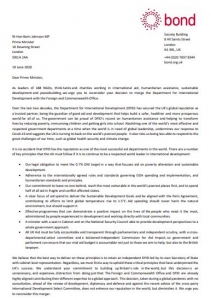
On Monday, 22 June, we joined nearly 200 NGOs and think tanks in writing to Prime Minister Boris Johnson to ask that he reconsider his decision to merge the Department for International Development (DFID) with the Foreign Commonwealth Office (FCO).

Spearheaded by the British Overseas NGOs for Development (BOND), the open letter highlights DFID’s excellent record on humanitarian assistance and warns the merger risks jeopardising the UK’s global COVID-19 response and the UK turning its back on the world’s poorest people. 

DFID leads the UK’s work to end extreme poverty by providing funding to organisations tackling global challenges, such as disease, conflict, and climate change.

Over the years, DFID grants have helped fund some of Doctors of the World/Médecins du Monde’s biggest projects, including our response to the West Africa Ebola outbreak and war in Syria.

With the world facing one of the biggest global crises in the COVID-19 pandemic, it is vital that DFID remains independent to ensure UK aid goes where it’s needed most – regardless of politics.

You can view a copy of the open letter below. Please read and share to help save DFID.

BOND’s letter to Prime Minister Boris Johnson.

Refugee Week: 7 ways you can get involved and support refugees

Published 19th June 2020

During Refugee Week 2020 (June 15-21), we invite you to support refugees and our work in seven simple ways. These can all be done from the comfort of your home and are inspired by this year’s theme ‘Imagine’.

This year, Refugee Week comes amid a global pandemic, which has put health at the forefront of people’s minds. This week is the perfect opportunity to not only celebrate refugees’ contributions and resilience, but also to call for their protection and universal access to healthcare.

By following these seven simple steps you can join us in imagining a better world for refugees.

1. See the world through a refugee’s eyes 

Can you imagine being forced to flee your home country because of war, conflict or persecution? 

Living in a place like the UK, it’s hard to picture yourself in this situation but not everyone is lucky enough to enjoy the safety and security this country offers.

Emmanuel Serrano is a Venezuelan refugee and policy and advocacy officer at Doctors of the World.

Doctors of the World policy and advocacy officer, Emmanuel Serrano, is one such person.

He has opened up about his experience leaving his home country Venezuela, where political turmoil and socio-economic instability have created one of the world’s biggest recent displacement crises.

Read and share Emmanuel’s story to promote understanding of why people seek sanctuary. 

2. Share our translated COVID-19 resources 

Did you know refugee and migrant communities have difficulty accessing COVID-19 guidance and key public health messages due to language barriers? 

We stepped in for these excluded groups, alongside the British Red Cross and several other partners, translating NHS guidance on coronavirus into 60 languages. 

Share now and save lives.

3. Find out if your GP is a safe surgery 

Everyone in England is entitled to basic primary healthcare, but many of our patients, including refugees, are wrongly refused GP registration.

As well as helping patients to register with a GP, we support NHS doctors, nurses and administrators to provide quality healthcare to all their patients.

Through our Safe Surgeries initiative, we provide practical resources and a professional training programme for NHS clinical staff.

Over 300 GP practices have committed to being safe surgeries.

Safe surgeries don’t refuse to register patients because they don’t have proof of address or identification – in accordance with NHS guidelines. They also never ask to see a visa or proof of immigration status.

So far, 341 practices across the UK have committed to being safe surgeries – is your GP one of them?

By following these seven steps, primary care staff can ensure that everybody can access healthcare when they need it.  

4. Ask the experts

On Thursday, we hosted a Twitter Q&A with the three public health doctors who co-wrote our report: “An unsafe distance: the impact of the COVID-19 pandemic on excluded people in England”

Catch up on the discussion about how refugees have been affected by COVID-19 and find out what you can do to help.

Got a question about our work or research? Our expert panel is happy to answer it.

Just comment on the thread and they will respond as soon as possible.

5. Buy a print for refugees 

Looking for the perfect print to brighten your home during lockdown? We’ve got you covered! 

Prints for Refugees offers a range of art prints generously donated by professional photographers, with all proceeds going to Doctors of the World.

Universal Experience I by Catherine Hyland

These donations could support our advice line, outreach team or remote GP consultations during COVID-19.

Help us to continue providing support for not only refugees but undocumented migrants, people experiencing homelessness and other excluded communities.

During Refugee Week, all prints are available with 10 per cent off.

To get your professional art print at a reduced price use the code “RW2020” at the checkout. This offer ends at midnight on Sunday.

Shop now.

6. Campaign for change

There are many ways we could make refugees feel more welcome in the UK and you can play a key role in bringing about that change.

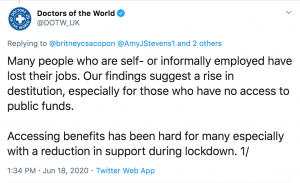
Migrants and asylum seekers with no recourse to public funds (NRPF) have been plunged into further poverty and destitution as COVID-19 and the accompanying control measures lead to job losses and create additional financial pressures.

We have joined over 40 migrants’ rights organisations in calling for the NRPF to be scrapped.  

Read and share our joint letter:

7. Sponsor a doctor 

If you can, please consider supporting our work with refugees.

One of the ways you can do this is by sponsoring a doctor.

Your monthly gift with help us to recruit and train new staff and volunteers, who in turn will help the most vulnerable access healthcare.

As little as £8 a month could provide essential vaccines, drugs and medical equipment for our doctors to use.

Meet some of the medical staff and interpreters you will be supporting.

For more ideas and inspiration, including upcoming events, visit the Refugee Week website.

“I did not ask to be born in Venezuela”

Emmanuel Serrano is a policy and advocacy officer at Doctors of the World UK. He is also a Venezuelan refugee.

For years the South American country has been plagued by violence, instability and political turmoil, forcing millions to flee.

According to the International Organization for Migration, approximately five million migrants and refugees have left Venezuela in what is one of the world’s biggest recent displacement crises. 

Emmanuel has been living in the UK for nearly two years and wanted to share his story.

Doctors of the World UK policy and advocacy officer, Emmanuel Serrano.

“I did not ask to be born in Venezuela; I was just very lucky. I have always loved and will love the country where I come from and never wanted to leave.

An authoritarian regime rules the nation where I was born and I fought against it from a very young age. I am proud to say that I was a councillor in my country’s capital when I was only 25 years old.

But the regime doesn’t like contrary voices. They threatened me and I had no choice but to flee from the land to which I owe everything.

At just 25, Emmanuel was a councillor in the Venezuelan capital, Caracas. He’s pictured visiting an impoverished community where he implemented a project with a nutritionist to help residents eat a more balanced diet.

Almost two years ago, I came to the United Kingdom.

My perception that this is a country with a very kind society, full of wonderful people, does nothing but grow. But after going through the UK asylum system, I have understood that the laws are not in accordance with the British society that is so kind.

From the border officer who greeted me with a smile and friendly conversation, my first GP who checked my asthma, to the supermarket cashier, it makes it hard not to say that everyone here is a great person. But every letter from the Home Office about my asylum case, with confusion and misinterpretations, generated mixed feelings.

But again, I was lucky. A first-tier tribunal judge understood that my claim for asylum was more than valid and fair. Today I’m a refugee.

An anti-government protest in Emmanuel’s electorate, where he also lived.

The truth is that I have much to thank the United Kingdom for. It has given me shelter and security, which I did not have in my own country. For this, I will be grateful until the last of my days. But not everyone has my luck, that’s why now I must help those who are going through difficulties like I did to make the road easier.

Reflecting on my journey, I am particularly grateful to the UK for giving me shelter. But I can’t stop thinking about all those who still need help.

Working at Doctors of the World, I can help ensure universal access to healthcare, thinking about all those undocumented migrants, asylum seekers or refugees who are too afraid or don’t have the means to seek medical treatment. This mission becomes even more important at a time when we are dealing with a global pandemic; when the health of one, is the health of all.

“With a neighbour and supporter from my party in a very poor and violent community. We did a significant activity that day to connect with the community and develop, later on, trust enough to do some political work with them.”

Reflecting on my journey, I am particularly grateful to the UK for giving me shelter. But I can’t stop thinking about all those who still need help.

The coronavirus crisis has taught us that there are no borders for challenges like this pandemic and that beyond practising physical distancing, it is time to work together and recognise that, just like a chain, every link counts if we are to remain united and strong.

I understand very well that on my journey I have been very lucky. But I know that I cannot always bet on luck, so I wonder – are we doing everything we can to put solidarity at the forefront and protect the chain or are we just betting on good luck?”


If you were inspired by Emmanuel’s story, help him provide support to other refugees and asylum seekers by making a donation.

Just £20 could allow Emmanuel’s colleagues operating the advice line to take a call from someone in need.

“I feel privileged to help”: Meet Doctors of the World’s longest-serving volunteer

Published 5th June 2020

Fourteen years ago, midwife Bettina Wanninkhof picked up a newspaper article that would kickstart a long and fulfilling career volunteering with Doctors of the World.

Bettina has reflected on her many years supporting excluded people to access healthcare during Volunteers’ Week, June 1-7.

Bettina Wanninkhof (right) is Doctors of the World’s longest-serving volunteer.

How long have you been a midwife?

I commenced my midwifery training in 1990 after five years working as a paediatric nurse. I went on to work full-time as a hospital midwife in southwest London until the end of 2004 when I enrolled on a Master of Science in Medical Anthropology. I have continued to intermittently work as a Bank midwife since then, mainly in the antenatal clinic of St. Helier Hospital, Carshalton.

How did you come to volunteer with Doctors of the World?

In 2006, while on the tube on my way home, I found an Evening Standard, which contained an article about Project London in Bethnal Green – the forerunner of today’s DOTW clinic in Stratford. The project sounded novel and worthwhile, and there was mention of a shortage of volunteers, so I applied (and was accepted) to work as a volunteer nurse at the new clinic.

I believe strongly that healthcare is a human right and while there are still health inequalities in the UK, feel privileged to be able to help to alleviate them in a small way.

I have been involved with DOTW for 14 years now – some years more intensely than others. I found my personal niche within the charity when the Women and Children’s Clinic started in 2014.

What drives you to volunteer after all these years?

I believe strongly that healthcare is a human right and while there are still health inequalities in the UK, feel privileged to be able to help to alleviate them in a small way.

How has Doctors of the World evolved since you first joined?

The principles of delivering clinical and advocacy support to vulnerable migrants and other people who have been unable to access mainstream NHS services has remained unchanged.

However, DOTW has grown in size and resources, and become a more established organisation since the early days in Bethnal Green. There is now an amazing purpose-built clinic, more advanced technology and multiple clinic supervisors to support and advise volunteers in the clinic and DOTW office.

A patient is seen at Doctors of the World's drop in clinic in Bethnal Green, London.
A patient is seen at Doctors of the World’s drop-in clinic in Bethnal Green, London. The volunteer doctors, nurses and support workers offer primary care and health care advice to excluded people including asylum seekers and undocumented migrants.

I stopped working as a health professional volunteer in the late 1990s as my nursing qualification had lapsed. Since then, I have been a support worker and used my midwifery knowledge in an advisory capacity. I enjoy the support worker’s role immensely as I am curious as to “how people tick”.

How often do you volunteer? How has your role been impacted by COVID-19? 

For some years now, Tuesdays and Thursdays have been my DOTW days. I spend Tuesdays in the Women and Children’s Clinic and Thursdays doing follow-ups. Follow-ups can, for example, involve checking that a woman has received her first antenatal care appointment, alerting a safeguarding midwife to a woman who is particularly vulnerable or finding a charity who can offer a destitute family baby equipment and a clothes bundle.

Having interactions with amazingly strong women who have survived and continue to survive in challenging circumstances has also been truly inspirational.”

COVID-19 has not changed the spirit of how DOTW works although the face-to-face sessions have been replaced by remote phone consultations. We are assisting fewer service users but have had to spend more time on the phone with those who have approached us for help. COVID-19 has made destitution worse for our client group who are already in dire straits!

What does a typical day in the Women and Children’s clinic look like for you?

Clinic days involves drinking a lot of coffee whilst seeing female service users (and to a lesser extent children), most of whom are new to the clinic. Many women are pregnant and need to be registered with a GP and be given information on how to access maternity services. They often also need information about maternity charges and signposting to charities who can help with food, immigration and housing.

We also see women who want to be referred for a termination of pregnancy and encourage all women to have STI testing and, if appropriate, take up the offer of contraception and free sanitary products. Older women also present to the clinic – many with chronic conditions, which they have self-managed but are at the point where health professional input is required.

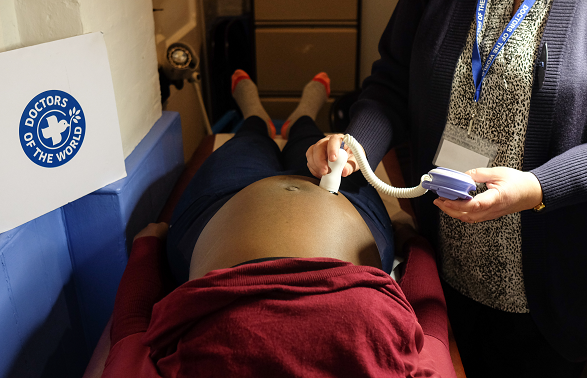
A pregnant woman is examined at Doctors of the World's family clinic.
A pregnant woman is examined at Doctors of the World’s family clinic.

What has been the highlight of your volunteer career with Doctors of the World so far?

Hearing British psychotherapist and human rights activist, Helen Bamber, speak at an early volunteer training day remains a highlight, along with being part of the DOTW family.

Having interactions with amazingly strong women who have survived and continue to survive in challenging circumstances has also been truly inspirational. The unfortunate truth is that it is the most traumatic cases (pregnancy after gang rape, for example) that are the most memorable (for the wrong reasons).

Anyone with an interest in migrant health or who wants to experience working with a service that strives to give holistic care to everyone walking through the clinic door should consider volunteering with DOTW.

A case that had a happier outcome is that of an undocumented Bangladeshi lady with a triplet pregnancy who was abandoned by her boyfriend soon after conception. Because this service user’s case was so unusual it was easy to find organisations willing to assist her.

She had early social services input, excellent antenatal care and access to a good (free) immigration lawyer who handled her asylum claim. She was allocated housing in London close to family members and when I last spoke to her, she and the babies were healthy and happy. I never did manage to source a triplet buggy for her though! 

Would you recommend volunteering with us? If so, why?

Anyone with an interest in migrant health or who wants to experience working with a service that strives to give holistic care to everyone walking through the clinic door should consider volunteering with DOTW.

Why would you encourage someone to support Doctors of the World?

COVID-19 has put health and the importance of the NHS to the forefront of people’s minds. It has also highlighted health inequalities among groups such as Black, Asian and Minority Ethnic communities, people experiencing homelessness and the elderly.

There is a sense that the world has become kinder and more tolerant. This sentiment should not be forgotten and DOTW will need to tap into this spirit to increase funding for UK projects, such as the Women and Children’s Clinic, which can transform lives.


Read more about Bettina’s experiences volunteering in the Women and Children’s Clinic here.

Joint letter: UK Government must scrap No Recourse to Public Funds policy

Published 2nd June 2020

Doctors of the World UK joins calls for the No Recourse to Public Funds policy to be scrapped amid rising destitution and demand for services

Doctors of the World UK has joined over 40 migrants’ rights organisations in calling for the No Recourse to Public Funds (NRPF) policy to be scrapped.  

It comes amid increased demand for the charity’s advice line service and following the release of its Rapid Needs Assessment, which found many excluded groups, but particularly those with no recourse to public funds, have been forced into further poverty and destitution during the COVID-19 pandemic.   

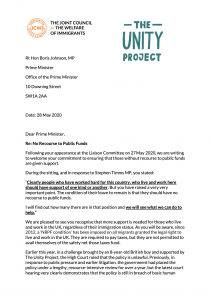
On May 27, appearing before the Liaison Committee, Prime Minister Boris Johnson committed to reviewing the NRPF policy, saying “people who’ve worked hard for this country, who live and work here, should have support of one kind or another”.  

In an open letter to the Prime Minister, over 40 migrants’ rights organisations in the UK, including Doctors of the World, have welcomed this commitment and outlined the urgent changes that are needed to protect individuals and families affected by NRPF restrictions.   

“Our staff have seen and heard first-hand the devastating impact of this ill-advised policy,” said Doctors of the World UK Policy and Advocacy Manager, Anna Miller.  

“Many people in excluded migrant groups live hand-to-mouth as a result of the NRPF condition, despite having the legal right to live and work in the UK and contributing to the very taxpayer-funded benefits programmes they are prohibited from accessing.”  

Miller said for those already living in or near destitution, the narrowing of job opportunities and additional financial pressures created by the pandemic has left them without enough to eat or stable accommodation.   

“Our Rapid Needs Assessment reveals excluded groups in England are experiencing new destitution and homelessness during the pandemic. This was particularly the case among those with no recourse to public funds,” she said.  

“Increased levels of destitution then increase people’s susceptibility to contracting COVID-19 and presents a risk to the health of the wider population.” 

The reported rise of destitution by interview participants is corroborated by Doctors of the World staff operating the charity’s advice line.  

“They report a significant increase in calls from people facing destitution since the start of the pandemic,” said Miller. “Doctors of the World has been required to divert resources to match this increase in demand.”  

The Rapid Needs Assessment, which looked at the pandemic’s impact on a wide range of excluded people, makes 12 recommendations, one of which is to immediately suspend hostile environment policies that prevent access to public services for migrants in vulnerable circumstances. 

“We must urgently act on the High Court ruling to lift the ‘no recourse to public funds’ condition on all visas,” said Miller.

“No one’s path to regularising their immigration status should be jeopardised or delayed in the process of removing NRPF conditions from a visa.”  

Find out more about the Rapid Needs Assessment and its recommendations here.

You can view a copy of the joint letter below.

An unsafe distance: the impact of the COVID-19 pandemic on excluded people in England

Published 22nd May 2020

Excluded groups such as sex workers and asylum seekers are being left behind in the UK’s COVID-19 response as control measures amplify existing health inequalities and put life-saving advice and care further out of reach.

The closure of services and some GP registrations, a lack of access to technology, distrust and fear of authorities, unsuitable or insecure accommodation, and reduced income are among the many challenges facing people in vulnerable circumstances in England. 

Doctors of the World UK has carried out a Rapid Needs Assessment (RNA) to better understand the experiences of excluded groups at the height of the COVID-19 pandemic, read our report outlining the study’s key themes and recommendations for removing barriers to information and healthcare .

You can read the full Rapid Needs Assessment here.

Working with service providers and people with lived experience, our researchers looked at the pandemic’s effect on a wide range of groups: refugees; people seeking asylum, including unaccompanied asylum-seeking children; undocumented migrants, including survivors of trafficking; people in and recently released from immigration detention; people experiencing homelessness, Gypsy, Roma and Traveller communities; sex workers and people recently released from prison. 

“Prior the pandemic, people in these groups already had poor access to health services,” said Doctors of the World UK Director of Programmes, Lucy Jones. 

“The pandemic has created additional barriers, reducing these groups’ access to healthcare and services further. Many do not have the resilience to cope with further deteriorations in their circumstances.”  

Pandemic amplifies inequalities

Participants in the RNA reported being unable to follow guidance on physical distancing and shielding because of unsuitable accommodation, being cut off from vital services and support networks, being unable to access advice and healthcare for COVID-19 and other health problems, and struggling to afford mobile data and food. 

“The RNA’s findings show COVID-19, and the government and societal response to it, have significantly impacted the health needs of these groups and widened the health inequalities they experience,” said Jones. 

She said many people belonging to the identified groups were likely to have: a higher risk of being exposed to the virus; a higher risk of health conditions that increase clinical vulnerability to COVID-19; and reduced access to and utilisation of healthcare services, putting them at increased risk of COVID-19 infection and associated serious health outcomes. 

“They are also more vulnerable to adverse impacts – as a consequence of the pandemic – on the social, economic and environmental factors that influence health and well-being,” she said.  

“COVID-19, and measures taken to control it, have pushed many individuals and families living in vulnerable circumstances into situations of actual or near crisis.” 

Collaboration and inclusion more important than ever

Chantelle Ntombi Matai, VOICES Network and Doctors of the World UK advisory board member, said GPs, hospitals and public authorities must work together to ensure everyone is included in the policies and services provided. 

“This report shows why we really need a stronger approach to make sure the right, accessible information and the support reach every corner of our community. This is only possible with the right training and awareness,” she said.  

“It offers a unique reflection on the new reality created by this disease, and why we need collaboration and inclusion more than ever.” 

Recommendations for change

The RNA makes 12 recommendations, identifying actions that must be taken to address the identified needs in both the immediate and longer-term. 

These include developing and disseminating guidance that can be understood by all people, ensuring it is accessible for people who don’t have access to digital services and immediately suspending hostile environment policies that restrict access to public services for migrants in vulnerable circumstances. 

“There are already some examples of positive actions undertaken to enhance inclusion during the COVID-19 crisis, including the provision of accommodation to people experiencing homelessness. Steps should be taken to ensure these are sustained and built upon,” said Jones. 

You can view of the key themes below.

This briefing highlights the key themes identified in the RNA.

Click here to read the full needs assessment and detailed recommendations for government, statutory bodies and service providers in the UK.

Everything You Need to Know About How Coronavirus Is Impacting The Homeless During Lockdown

Published 11th April 2020


You’ve probably read in the news about the government pledging to house rough sleepers during the Coronavirus crisis. But what does this actually mean and how does it work in practice?

Doctors of the World have been working on the streets of London for the last six months and providing medical outreach and support to people who are street homeless.

We spoke to Durga, our Mobile Clinic Coordinator and a GP, about the impact of Coronavirus and she answered some common questions.


People who are street homeless have been offered rooms in hotels that have been procured by local authorities. The hotels are divided into floors for different groups.

There is a floor for people with symptoms and who need to self-isolate. There are then floors for people with no symptoms and these are split between those with people with good general health and those with underlying conditions.


Would we provide medical support in the hotels?

Ideally, yes. However, we don’t currently have the funding, staff or volunteers. If money was no object then we would do this. The staffing and volunteer situation is hard, as there are such high demands on other parts of the health service.

For example, Durga is also a GP and she is need at her surgery, as much as she would like to increase her hours at this time. We’re working to look at how we can solve this problem. If everyone was off the streets, then we would look to switch our service.


What hotels are being used?

In the City of London, a number of Holiday Inns are being used. These have been stripped back to basics in terms of staffing. The rooms have also been modified to be as basic as possible. There are no running kitchens, which poses logistical problems around food.

For example, we don’t want people to leave the hotel to go looking for something to eat. The team are working with soup kitchens and other providers to make sure everyone has access to sufficient food.


How have we changed our service?

We have stopped using our van due to the increased risk of transmission when in a confined space. We then switched to on-foot outreach with a focus on Coronavirus. Our colleagues alert us to people they are concerned about who may have symptoms or who are particularly vulnerable.

We’ve also switched from a night service (when people are stationary) to a day service. This is due to safety concerns of working in a deserted city. However, if we are unable to help those in most need, then we will switch back to an evening service, but with a police escort.


What happens if someone refuses to go into the hotel?

It depends on the reason for refusal. If there are no concerns about capacity or mental health, then the police have the power to enforce isolation.

If people have a mental health problem and there are concerns around capacity, then the Mental Health Act or Mental Capacity Act can be used to enforce isolation.

Both of these need to be done in partnership with the police.


As well as Coronavirus concerns, then there is increased anxiety and mental health issues. However, the support can vary depending on where you are.

There are also worries about people with drug and alcohol dependencies and the need to offer detox support if people are going into the hotels.


Why are Doctors of the World in the best position to help?

It is interesting how this has increased collaboration with other services. The way the homeless support has been put together quickly provides a model for how we can improve planning and support in the future.


And finally we ask Durga how it would change the way we work in the future.

We hope you’ve found this summary interesting. Please, if you can, support Durga and the team by donating to our Coronavirus Solidarity Fund.

Coronavirus Global Solidarity Fund

Published 19th March 2020

“We cannot forget migrants, we cannot forget undocumented workers, we cannot forget prisoners in prisons.” Dr Michael J Ryan, Executive Director, WHO Health Emergencies Programme on why we mustn’t forget the vulnerable and excluded when tackling Coronavirus.

Doctors of the World is committed to helping these groups. That’s why today we’ve launched our Coronoavirus Global Solidarity Fund. This emergency fund will help keep our services for the most vulnerable running through, and beyond, the current crisis. Please, if you can, do give today .

We’re all worried and a little scared

Coronavirus is making us all feel nervous, agitated and worried. It is an unprecedented time in our recent history and we need to come together to overcome this terrifying pandemic.

This is all putting a great strain on healthcare around the world. We know from experience that when this happens it is often the most vulnerable groups of people that are hit hardest.

Here at Doctors of the World, we are working with our colleagues and partners to do all we can to mitigate the impact of this global pandemic.

As you can imagine, this costs money. That’s why today I’d like to ask you to give to our Coronoavirus Global Solidarity Fund. We will use this money to continue to provide our services and help those most in need.

Some of this will help us continue our ‘business as usual’ work and some will be for new projects that arise from the emergency.

We’re already adapting our work to help

For example, we have already translated advice for patients in 49 languages. These were produced in partnership with the Red Cross, Migrant Help and Clear Voice at no charge to patients. As guidance changes, we will update these.

As Dr Ryan ends by saying:

‘We’re in this together, and I hope we can finish this together’

Please, if you can, give generously now. Together we can help those who need us most.

International Women’s Day 2020: what it means for our clients, volunteers and staff

Published 6th March 2020

Claire strikes the #EachforEqual pose – the symbol for IWD 2020

To mark International Women’s Day on Sunday 8 March, we asked to Claire van Nispen tot Pannerden, Women’s and Children’s Project Lead at our London clinic to reflect on what the day means for our patients, clients and staff:

“Coordinating the Women and Children’s clinic every Tuesday makes me feels so humble and so grateful.

“I have the privilege to meet many women, who are so brave. They have made the decision to ask us for some support. They have made a decision to speak and share a bit of their past with us. A hugely brave step.

“I am grateful to work with amazing, diverse and experienced volunteers – all women in the Women and Children’s clinic. I am equally grateful to be part of the team offering women the support they came for and sometimes a little bit more. 

“I am inspired by them, by their journeys, their bravery of coming, their sharing and especially their incredible strength. 

“I am celebrating International Women’s Day for all women and girls this Sunday, and continue to celebrate women and girls on all other days.”

The theme for this year is #EachforEqual and Claire is striking the #EachforEqual pose in solidarity with women around the world.

As the website explains:

An equal world is an enabled world.

Individually, we’re all responsible for our own thoughts and actions – all day, every day.

We can actively choose to challenge stereotypes, fight bias, broaden perceptions, improve situations and celebrate women’s achievements.

Collectively, each one of us can help create a gender equal world.

This theme is drawn from a notion of ‘Collective Individualism.’

We are all parts of a whole. Our individual actions, conversations, behaviors and mindsets can have an impact on our larger society.

Collectively, we can make change happen. Collectively, we can each help to create a gender equal world.

We can all choose to be #EachforEqual.

x

With your support, Doctors of the World will make sure nobody suffers or dies due to lack of access to healthcare.