The border is brutal

Published 15th December 2017

We recently spoke with Biljana Stankovic, Doctors of the World General Coordinator in Bulgaria, where our teams provide medical care to people in refugee camps and advocate for the rights of refugee children, who are often exposed to dangerous situation or find themselves without families or relatives after their traumatic journey in search for safety.

Biljana expressed his views on the current crisis:

“Smuggling will not stop. This is a long standing route in to Europe. Current numbers are always skewed lower than the reality.

“Afghanistan is rated as a ‘safe’ country by Bulgaria. But people will continue coming, they can’t go back. Their lives or their family’s lives have been threatened – they need to keep going. Despite being beaten and turned away, they will keep returning until they find a way as they have no other choice.

“The Hungarian border is brutal. One of own translators was beaten there. Skulls are broken. People are sent back from borders without food and drink to walk for two or three days through the forest back to Bulgaria.

“We’ve been shown footage of the police putting on balaclavas and beating refugees”.

We also spoke with one of the doctors working in the camps and reception areas. He explained about some of the conditions he sees.

“I see lots of bites and rashes from insects. We also see lice from people who have been in reception centres. People come in ‘having come into contact with physical objects’  – I couldn’t say if they have been beaten with batons. I often see new people with dog bites from border police.

“When people first arrive coming in with injuries related to long journeys – joint swellings, bleeding feet.

“I saw four people today. The difference between a consultation in the camp and the one in a hospital is time. In the camp people need time to talk, to tell you what is really wrong with them.

“Doctors have certain status in middle eastern countries so in many refugees’ eyes a doctor has status. If you are willing to just listen to their problems it makes them feel that someone important is listening to them. It gives them a voice.

“The hardest part of my job is doing it through a translator. I need to explain in a way that it makes it easy for the translator to then explain. Medical intervention is only about 30% of my role. The rest is listening and giving time to people.”

While visiting our teams in Bulgaria we also met some of the children who live in the camp.

You can watch in the video below the story of Abbas, aged 12, who lives in Harmanly Refugee Camp, in the outskirts of Sofia. Doctors of the World help children like Abbas, whilst advocating for their right to safe and separate accommodation, and helping reunite them with their relatives in Europe.


It is only thanks to your support that our volunteers can continue to listen and help, and our patients can find a safe place to share and heal from their traumatic experiences. Please do consider giving generously to our winter appeal in support of families and children in refugee camps across Europe and the Middle East.

CELEBRATE GIVING TUESDAY WITH DOCTORS OF THE WORLD

Published 21st November 2017

Doctors of the World is taking part in #GivingTuesday on Tuesday 28th November. Will you help our medical teams do something amazing?

What is it all about?

Over the last 6 years, #GivingTuesday has grown from a grassroots movement in the US to become a global phenomenon, acting as a response to the commercialisation and consumerism of Black Friday and Cyber Monday.

What is the key message

  • Doing something good for charity is fun!
  • There are loads of ways to give…
  • Anyone can do good!

Why are we taking part to Giving Tuesday

Doctors of the World relies on the financial support of our amazing donors to run activities and programmes that are providing much needed medical care to many people across the UK and the world.

Last year, 1 in 10 people did something good for charity on Giving Tuesday here in the UK, with a world record set for the most money raised online for charity in 24 hours.

We would love for you to help us promoting this fundraising initiative and our cause. Below are some ideas on how you can help on the day.

WHAT YOU CAN DO ON GIVING TUESDAY

Donate via our Facebook page – starting from 12AM Tuesday 28th November Facebook will match all donations received via our Facebook page up to £10,000! If you want for your donation to go even further simply click the donate button on our Facebook page header after 12AM – UK time, and donations will be matched. But hurry, the matching fund is available only until it runs out.

Do a Santa Run for us and raise funds for our medical teams – celebrate Christmas and Giving Tuesday by taking part to our London Santa Run, or set your own challenge in December. It could be your chance to eat as many mince pies in one go, for example!

Bring Christmas cakes to the office and organise a collection among your colleagues. You can also ask your company or employer to match all the funds raised.

Be active on social media! Share our posts and messages on Facebook and Twitter and use hashtag #givingtuesday, asking your friends to donate to Doctors of the World and support the work of our amazing volunteers.

Donate to our Christmas Appeal – this winter you can help children like Saeer and people living in refugee camps across Europe and the Middle East to get all the support they need during the winter months. Winter can be harsh, and children in camps face many risks. Doctors of the World teams will be there to provide safety, protection and care. Will you help our volunteers this winter?

Be an ethical consumer – It is still difficult to avoid looking for presents this time of the year, but you can still do something good while you buy. Why not purchase a pack of our RealityXmas cards or an art print on Prints for Refugees website, with all the proceeds going to Doctors of the World?

Whichever way you decide to celebrate we would love to hear from you!

Please contact us at events@doctorsoftheworld.org.uk if you have any ideas you would like to discuss or resources you might need.

Don’t forget that you can easily organise a fundraiser online by setting up a page on Justgiving.

Patients in Europe are falling through the cracks

Published 7th November 2017

“Universal health coverage is a human right”. This was a welcome statement from the new Director General of the World Health Organization, Dr Tedros Adhanom Ghebreyesus.[1] Europe, as one of the most affluent parts of the world with an admirable history of social protection and welfare states, should be leading the way in ensuring this human right is not violated for anyone, regardless of ethnicity, sex, language, colour or immigration status.[2] And yet The European Network to Reduce Vulnerabilities in Health Observatory Report[3], published this week by Médecins du Monde, provides evidence of the systematic failure of European health systems for many people currently living within the region.

The Observatory Report provides an overview of the European programmes run by Doctors of the World/Médecins du Monde (MdM) and partner non-governmental organisations across Europe. It contains data from 43,286 people who were a mixture of EU nationals, EU and non-EU/EEA migrants, and seen in clinics in 13 different European countries in 2016. The report describes the plight of individuals who were unable to access healthcare services, detailing how they were excluded and outlining their underlying health needs. 55.2% of individuals attending MdM associated programmes stated they had no access to healthcare coverage, with a further 18.3% reporting coverage for emergencies only. Administrative barriers, cost and fear of being arrested were all common reasons for the lack of access. The introduction of upfront charging of overseas visitors using the NHS[4], and disclosure of patients’ data to the UK Home Office[5] for immigration enforcement, are examples of the drivers of these findings and must be condemned and withdrawn.

This lack of access, to even basic healthcare provision, could have severe consequences for many. For example, all pregnant women should have early access to antenatal care and yet the majority – 58.4% – had not received any such care before seeking help from MdM. This lack of attendance to healthcare facilities puts the lives and health of these mothers and their children at great risk. Urgent plans should be put in place across Europe to ensure these women gain the same standard of antenatal care as others, wherever they reside.

Vaccination levels in children, who made up one fifth of those seen, were low and present an ongoing risk to European-wide communicable disease control. Measles requires vaccination coverage levels over 90%[6] to ensure herd immunity, and yet reported levels of MMR vaccination were only at 68.5% in children under 18. Public Health colleagues across Europe should review their vaccination provision for the groups highlighted in the report and ensure there is an equitable service that can reach children currently being missed or excluded. A failure to take this enlightened self-interest approach will result in non-discriminatory outbreaks that affect everyone.

The needs of individuals seen in MdM clinics were significant and illustrate the extent to which some individuals in our society remain highly marginalised. It highlights how people who are living in precarious circumstances, poverty, those who lack social networks, or who have migrated to a new country, are received by our healthcare systems. The only conclusion that can be made from the data is that European healthcare systems do not serve these individuals well, that their rights are not being met, and that healthcare coverage remains far from universal.

The EU and its constituent national governments need to take urgent action to respond to the findings of this report. The EU should support European-wide solutions to assist policy making to meet the health needs of the groups seen by MdM. National governments must ensure that administrative and economic barriers are removed for everyone in society, and make unequivocal guarantees that healthcare systems will not be used to enforce border control policies – vulnerable people should not fear arrest when seeking healthcare. These reassurances and changes in practice will benefit all people in Europe, not just the marginalised who are currently falling through the cracks in universal healthcare coverage.

You can download the Report’s Executive Summary here. To access the full report, click here.

This piece was written by Rob Aldridge, a Wellcome Trust Clinical Research Career Development Fellow at University College London’s Institute of Health Informatics, Delan Devakumar, NIHR Clinical Lecturer in public health in the UCL Institute for Global Health and Ibrahim Abubakar, Director of the UCL Institute for Global Health.

The authors partnered with MdM/Doctors of the World to produce the Observatory Report. It was originally published in BMJ Opinion

References

1          Ghebreyesus TA. All roads lead to universal health coverage. Lancet Glob Health 2017;5:e839–40. doi:10.1016/S2214-109X(17)30295-4

2          Universal Declaration of Human Rights. 2015.http://www.un.org/en/universal-declaration-human-rights/ (accessed 2 Nov 2017).

3          Robert W Aldridge, Anna Miller, Bethany Jakubowski, et al. Falling through the Cracks: The Failure of Universal Healthcare Coverage in Europe. London: : European Network to Reduce Vulnerabilities in Health 2017.

4          Hiam L, McKee M. Upfront charging of overseas visitors using the NHS. BMJ 2017;359:j4713. doi:10.1136/bmj.j4713

5          Casla K, Roderick P, Pollock AM. Disclosure of patients’ data to the UK Home Office must stop. BMJ 2017;358:j3613. doi:10.1136/bmj.j3613

6          Cockman P, Dawson L, Mathur R, et al. Improving MMR vaccination rates: herd immunity is a realistic goal. BMJ 2011;343:d5703. doi:10.1136/bmj.d5703

Doctors of the World joins push to help civilians in Ukraine’s forgotten conflict

Published 27th October 2017

Doctors of the World has worked with a number of international humanitarian groups to launch a project that will help over 163,000 people on both sides of Ukraine’s conflict.

Eastern Ukraine’s conflict is now in its fourth year and risks becoming a forgotten battleground. Over 10,000 people – including nearly 3,000 civilians – have been killed and critical infrastructure has been damaged. Thousands of civilians living close to the conflict’s “contact line” are suffering under continued shelling.

Doctors of the World, People in Need, Action Contre La Faim, and ACTED will provide additional humanitarian assistance to over 163,000 people on both sides of the contact line. The EU is providing €4.1 million to support this project, which will be carried out in partnership with IMPACT Initiatives.

The Doctors of the World network works in Ukraine’s Luhansk province. Our mobile clinics go to villages near the contact line and provide desperately-needed primary care and mental health support to isolated people. We work in both government-controlled and non-government-controlled areas.

In the divided parts of the Luhansk and Donetsk regions, citizens struggle to get by because social and financial services have been suspended. The movement of people and goods across the contact line is highly restricted, making life extremely hard especially in terms of access to medical care.

“My dad has had two strokes and for the last seven years he’s barely been able to stand up,” says Maryna (pictured above), who lives in Zolote 4, one of the villages where we work.

“To call an ambulance to our village is very problematic – there are so many checkpoints, they often do not allow the ambulances to pass. So you can die 10 times while waiting for an ambulance.”

An estimated four million people in eastern Ukraine are in need of humanitarian support. Humanitarian groups are doing their best but there is a serious lack of funding for and international attention to this crisis.

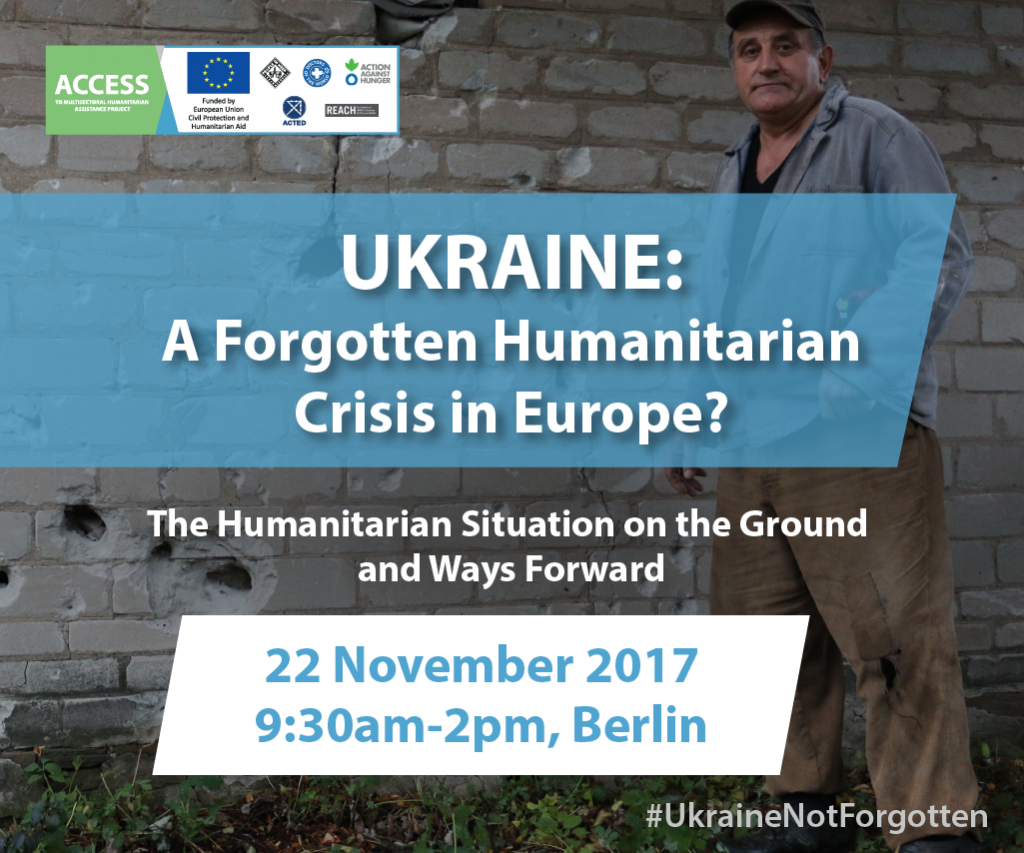
In order to draw attention to the crisis, Doctors of the World UK and partners People in Need, Action Contre La Faim, ACTED and IMPACT Initiatives, are hosting a conference on the ongoing conflict, its humanitarian consequences, and ways forward. With the title, Ukraine: A Forgotten Humanitarian Crisis in Europe?, the event will take place in Berlin on 22 November 2017, 09:30-14:00 local time. Panelists include representatives of German Foreign Office, the United Nations, international and local NGOs, EU representatives as well as Ukrainian officials and civil society representatives. Follow the event on Twitter (#UkraineNotForgotten) or on Periscope @ACF_Deutschland.

Doctors of the World’s medical teams treat traumatised people in dangerous and difficult places around the world. Please donate now to help us save lives. 

New research shows how NHS charges deter patients in need

Published 20th October 2017

New Research_brief_KCL_upfront_charging_research_2310 has shown the dire impact that NHS hospital charging has on the most vulnerable members of our communities, as rules come into force that significantly extend both ID checks and charges.

Over a third of Doctors of the World patients affected by NHS hospital charging have been deterred from getting care, including heavily pregnant women and people suffering from cancer, diabetes and kidney failure, according to new studies.

The research, conducted by post-graduate students at Kings College London at our clinic in Bethnal Green, reports NHS patients being charged up to £80,000 for their treatment. This often left vulnerable people with debts they were unable to clear, even years later.

The two studies, conducted in 2015-2017, used interviews with Doctors of the World patients, clinic staff, volunteers, and GPs, along with analysis of patient records. The Independent has covered the studies today.

The research comes as new rules come into force on 23 October that require all hospitals and many community health services to ID and charge some migrants, in a marked expansion of the previous rules.

Doctors of the World is totally against these new rules, which will make it even harder for vulnerable people to get the healthcare they need. Earlier this month we sent a high-profile letter, signed by medical Royal Colleges and a former NHS chief, to Health Secretary Jeremy Hunt to call for the rules to be scrapped.

Amongst the patients surveyed for the research, fears of being given bills they couldn’t pay and being reported to the Home Office were major concerns.

The health risks for mothers and children were particularly stark. UK guidelines recommend that a pregnant woman has her first antenatal appointment at 10 weeks, but almost 2 in 3 of pregnant women in the new research had not had one by that time and 1 in 4 had not been seen at 18 weeks.

In one case, a woman had not accessed antenatal care until 37 weeks into her pregnancy. At least two women who came our clinic were contemplating abortion in order to avoid being sent a bill.

Claire Ferraro, an NHS doctor and Doctors of the World staff member, said: “Abortion is a deeply personal choice. We should not be putting women in a position where they feel that this decision is imposed on them by the high price of pregnancy and birth in today’s NHS.”

The new charging rules mean that all community health organisations in England that receive NHS funding will be legally required to check every patient’s immigration status. If the patient cannot provide ID to prove they are exempt from charges, they will have to pay in full before receiving any treatment.

The regulations are set to affect all community health services including school nursing, community midwifery, community mental health services, abortion services, and specialist services for homeless people and asylum seekers.

The government charging programme is called “Making a Fair Contribution”, but upfront charges are set at 150% of the costs of treatment and therefore go far beyond this aim. Instead, these charges force many destitute people into impossible situations.

Demanding full payment before treatment means that patients cannot set up a manageable plan where they pay in monthly installments – the only way that many of our patients can contribute.

A Doctors of the World research briefing, which summarises the studies’ findings and draws out policy implications and recommendations, can be found Research_brief_KCL_upfront_charging_research_2310.

Links to the original research are here: Ockert-Axelsson_Capstone_Report_v1.1; Jennifer_Quy_KCL_Capstone_v1.1


Thank you for your supportive messages for Ahmad

Published 13th October 2017

By Shyamantha Asokan

Ahmad is a doctor and a Syrian refugee, who arrived in the UK last year. He’s living in London and volunteering at our clinic, while he studies for the tests required to work in the NHS.

We published Ahmad’s story on our website recently and we had an amazing response. Dozens of people emailed us with supportive messages for him, commending him for volunteering and wishing him all the best for his new life here in the UK.

Ahmad had to flee Syria in 2014 after he was arrested and jailed for treating wounded people in towns under government siege. His specialism is oncology and his ambition is to work as an oncologist in the UK.

“It really meant a lot to me when I saw that people had sent nice words of support and encouragement. I swear I can’t find enough words to say thank you. So, thank you from the bottom of my heart,” Ahmad said after reading the messages. You can watch his message to everyone who sent their good wishes in the video above.

Cath, one of our supporters who is a cancer patient, sent a message to Ahmad about how much she values oncologists. Here’s Ahmad reading out Cath’s message and giving his reply:

Jon, another of our supporters, wrote to us from Canada to tell Ahmad he’d been so inspired by his story that he was going to volunteer to help refugees in his area. Here’s Ahmad reading out Jon’s message and giving his reply:

Thank you to everyone who sent supportive messages to Ahmad. Our clinics across London, where we treat vulnerable patients such as asylum seekers, undocumented migrants and homeless people, rely on volunteer medics and caseworkers. We couldn’t do our work without brilliant people like Ahmad.

Doctors of the World’s medical teams find and treat vulnerable people around the globe. Our projects are made possible by volunteers. Please donate now to help us save lives.


Former NHS chief joins our call to scrap new ID checks and charges for patients

Published 11th October 2017

A former head of the NHS and hundreds of individual medics have joined our call for Jeremy Hunt, the UK’s health secretary, to scrap new rules that will force community health workers to ID and charge some migrants.

Four charities – Doctors of the World, Asylum Matters, the National Aids Trust, and Freedom From Torture – created an open letter to Mr Hunt setting out the serious risks posed by the rules, which have been brought in without parliamentary scrutiny or proper consultation with NHS staff.

The letter was delivered to Jeremy Hunt on 9 October and has been covered by the Guardian today.

Over 190 organisations and groups signed the letter, ranging from high-profile bodies such as the Royal College of Midwives, the Royal College of Paediatrics and Child Health, and Amnesty International UK, to local services for vulnerable patients such as homeless people and asylum seekers.

Former NHS CEO Sir David Nicholson and over 430 individual medical professionals, including over 350 doctors and nurses, have also signed. There are 1,078 signatories in total.

From 23 October, all community health organisations in England that receive NHS funding will be legally required to check every patient’s immigration status. If the patient cannot provide ID to prove they are exempt from charges, they will have to pay in full before receiving any treatment. The fee will be 150% of the cost of their treatment.

The regulations are set to affect all community health services including school nursing, community midwifery, community mental health services, abortion services, and specialist services for homeless people and asylum seekers.

Even charities that receive NHS funding and provide these services will come under the rules. Upfront charging – charging before treatment – for many types of hospital care will also commence.

Doctors of the World totally opposes these new rules, which will force health workers to turn away patients who don’t have the ID documents required or can’t afford to pay. The rules will further deter some of the most vulnerable members of our communities, such as homeless people and victims of trafficking, from getting healthcare.

“We want to send a clear message to Jeremy Hunt that forcing health workers to check passports and act as proxy border guards is wrong. We’re delighted that high-profile Royal Colleges and hundreds of individual medics have joined our call,” says Leigh Daynes, executive director of Doctors of the World UK.

“At our clinics, we see destitute cancer sufferers, pregnant women and children who are already too afraid to see an NHS doctor because of their immigration status. These new rules will make the current climate of fear amongst our patients even worse.”

The government has made multiple commitments to assess how extending NHS charges will impact vulnerable people, pregnant women and children, but this has not happened. It estimates that extending charges beyond hospitals and into services such as those provided by charities are likely to recoup just £200,000 a year – 0.00016% of the NHS’ total annual budget.

The rules have been introduced in two stages, with the first taking place in August.

The UK already charges some non-British patients or their home countries for most NHS secondary care (hospital care) after their treatment. Accident & Emergency hospital treatment and GP surgeries are currently exempt, but the UK government has been clear that charging could be extended to these services in the future.

UPDATE, 17 October 2017: Our open letter was sent to Jeremy Hunt on 9 October 2017. Since that date, a number of other bodies have also endorsed the letter, including Unison and the TUC. An updated letter with a full list of signatories can be found here.

World Mental Health Day: Treating invisible wounds

Published 10th October 2017

In many parts of the world, a silent crisis in mental health is unfolding.

Almost half of the world’s population live in a country with less than one psychiatrist per 100,000 people. One in three refugees in camps on the Greek island of Chios has witnessed a suicide. Sierra Leone has just two psychiatrists to help its population cope with shock and grief after the Ebola epidemic.

Doctors of the World’s medical teams work in dangerous and difficult places around the globe, and our teams often include brilliant psychologists and psychiatrists. On World Mental Health Day, we want to thank them and showcase some of the work they do to heal invisible wounds.

GREECE

There are over 60,000 refugees stuck in Greece, living in unsafe and unhealthy camps while they are assessed for a possible return to Turkey or permission to join relatives in Europe. In practice, the 2016 EU-Turkey deal has simply created a backlog of claims and appeals, leaving people confined to Greece’s islands.

These men, women, and children are increasingly suffering from mental health problems such as self-harm, suicide attempts, depression, aggression and anxiety. Our psychologists work in these camps to hold one-on-one and group sessions with people in need.

UKRAINE

In towns near eastern Ukraine’s “contact line”, the frontline of a three-year conflict, the sound of shelling rattles through the air at night. While many young people have fled the area, parents and pensioners are often unable to do so. In these ghost towns, isolated people suffer from anxiety, panic attacks and insomnia.

Doctors of the World UK started working in the Luhansk region of eastern Ukraine in 2015. Our psychologists go to villages in mobile clinics and help people like Ludmila (pictured above), who had a nervous breakdown due to the conflict. “Once I opened up to the psychologist, I felt like a hand of salvation had reached out to me,” she says.

You can watch a video about our mental health work in Ukraine here.

NEPAL

In 2015, Nepal’s strongest earthquake for a century killed over 8500 people. Two years on in Sindhupalchok, the worst-hit district, local women are still helping people recover from the earthquake’s psychological impacts. Women in these villages say mental health issues and drinking are on the rise, partly as many people are still unable to rebuild their houses and start anew.

We have a mental health team doing outreach work in these villages. We also run workshops for local women whom we’re helping to run micro-loan projects, build health clinics, and offer counselling.

THE UK

After the Grenfell Tower fire, a staggering 600 survivors and neighbours needed counselling. One hundred of those in need of mental health support were children.

We held two “self-care” workshops for people working with Grenfell survivors, in order to help care-givers look after their own mental health while supporting those in need. “Self-care” is an under-reported issue and care-givers are prone to burnouts if they don’t protect their mental health while handling other people’s grief

LEBANON

In Lebanon, roughly one in five people is a Syrian refugee. Many of these refugees went through traumatic experiences at home and now live in camps. But Lebanon’s mental health services are largely privatised, concentrated in the capital Beirut, and suffer from shortages of professionals. As a result, refugees suffering from conditions such as PTSD have no one to turn to.

Our psychologists in the Bekaa Valley are treating refugees, including many child refugees. We’re also working with Lebanon’s government to establish the first mental health unit in a public hospital in Beirut.

Doctors of the World’s medical teams treat traumatised people in dangerous and difficult places around the world. Please donate now to help us save lives. 


Global Safe Abortion Day: every woman has the right to be in control of her body

Published 28th September 2017

Around the world, women who need an abortion are being forced to resort to backstreet clinics and life-threatening “alternative” methods. In Burkina Faso, some women drink coffee mixed with antibiotics. In the Gaza Strip, some women breathe in harmful chemicals.

Doctors of the World’s medics see first-hand how women suffer when they can’t access safe and legal abortions – the examples above are just two glimpses into our findings in the countries where we work. As the world marks Safe Abortion Day on 28 September, we’re calling for every woman to be able to get the medical care she needs.

“We believe every woman has the right to be in control of her body, and to decide if and when to have children,” says Leigh Daynes, executive director of Doctors of the World UK. “Following Donald Trump’s outrageous decision to reinstate the “Global Gag Rule”, it’s more important than ever to stand up for this right.”

Almost 1 in 2 women live in countries where abortion is banned, restricted or not accessible. This year, US President Donald Trump has also cut funding for several charities that provide or counsel women on terminations.

Research released today shows that almost half of all abortions globally are unsafe, including 8 million terminations a year that use highly risky methods such as inserting wires into women’s bodies. Unsafe abortions kill tens of thousands of women a year, and mean that at least 7 million more end up in hospital.

Giving women access to family planning services, which include safe abortions, avoids these health risks and also boosts their economic independence.

“If you dare abort, you’ll die!” A nurse told Merlyne (pictured above) when she became pregnant in her late teens. Merlyne lives in Kinshasa, the capital of the Democratic Republic of Congo, where abortion is illegal in most circumstances.

As a result, Merlyne went on to have a baby for whom neither she nor her partner were ready. Merlyne worries because she and her baby are now an extra financial burden on her parents.

The Doctors of the World (Médecins du Monde) network works in Kinshasa to educate adolescent girls like Merlyne about their sexual and reproductive health. We’ve run similar projects for women in Nepal for a decade. In Haiti, we advocate for abortion to be decriminalised and train health workers to treat abortion-related complications.

Our network also supports the Family Planning 2020 partnership. In July, we committed to help 1 million women in 13 developing countries access family planning services and information.

Women in wealthy countries can struggle to access abortions too. Ireland bans terminations in almost all circumstances. This week, the country’s leaders announced a 2018 referendum on its abortion laws.

In the UK, Doctors of the World’s clinics help a range vulnerable people who are struggling to get healthcare, including women who wish to access abortion services. Last year we helped Helen, who was homeless and had been wrongly turned away from four NHS GP surgeries. We spent several weeks helping her to register with a GP and get the abortion she wanted.

“It was a turning point for me,” says Helen who now has a job as a chef and a place to live. “If I had had a baby while I had such a complicated life, it would not have been good for anyone. Having children is a good thing, but I couldn’t do it at that time.”

Our medics work with marginalised women in refugee camps, conflict zones, remote villages, and other tough situations around the world. Please support our work on this and other pressing medical issues by donating today.

Doctors of the World’s #RealityXmas cards win prestigious award

Published 22nd September 2017

We’re delighted to announce that our #RealityXmas cards, designed by McCann London, have won a prestigious Third Sector award.

Our 2016 Christmas cards starkly juxtaposed vintage biblical nativity scenes with modern-day photographs of Middle East conflict zones. The cards, which had names including ‘Not So Silent Night’ and ‘The Star of Bedlam’, featured photojournalism from Associated Press taken over the previous year.

The cards have won a series of awards this year, with the Third Sector prize announced at an awards ceremony on 21 September.

Rather than making a religious statement, the #RealityXmas cards sought to remind the public that in 2016 war had forced millions of people from their homes and they urgently needed our help.

Conflict in the Middle East has led to the biggest forced displacement of civilians since the Second World War. Our teams of doctors, midwives and psychologists continue to work in refugee camps across the Middle East and Europe to reach those in need.

Last year, our first batch of cards sold out in 48 hours and our #RealityXmas campaign was covered by publications such as CNN, TIME magazine and the BBC. At the end of the campaign, we delivered a giant card to Downing Street containing a petition that demanded proper aid access to Aleppo.

We’re hugely grateful to McCann London for designing these daring cards and helping to raise awareness of our vital work. Here’s a photo of us at the awards ceremony last night!

We still have some #RealityXmas cards left if you’re stocking up for this year. You can buy them here. All proceeds will support our medical teams around the world.

The UK is forcing health workers to be proxy border guards

Published 19th September 2017

UPDATE, 17 October 2017: Our open letter was sent to Jeremy Hunt on 9 October 2017. Since that date, a number of other bodies have also endorsed the letter, including Unison and the TUC. An updated letter with a full list of signatories can be found here.

The UK government is ratcheting up its strategy to inflict misery on undocumented migrants – and it’s forcing charities and community health organisations to help.

While the British government has long charged undocumented migrants for many types of non-emergency NHS hospital care, charges are now also being introduced for services provided by community health organisations. This includes community-interest companies and charities.

The new regulations will affect a wide range of health services, such as school nursing, community midwifery, community mental health services, termination of pregnancy services, advocacy services, and specialist services for homeless people and asylum seekers. GP surgeries are exempt.

From 23 October, all community health organisations in England that receive NHS funding will be legally required to check every patient’s immigration status to see whether they should pay for their care. If the patient is an undocumented migrant, they will have to pay in full before receiving any treatment.

Doctors of the World is calling for these heartless rules to be withdrawn, and for the impact of charges to be properly assessed.

“The human impact is likely to be huge. People who have experienced trauma and violence, such as victims of trafficking and exploitation, will no longer be able to access essential community services as they simply can’t afford them,” Lucy Jones, who runs our UK programmes, told The Independent this week.

“The government is effectively making a whole host of community health workers into proxy border guards – from school nurses to charity workers to trauma counsellors. It’s a huge burden on people who just want to do their jobs, not carry out the Home Office’s work.”

At our clinics across London, we treat vulnerable patients including asylum seekers, undocumented migrants, victims of trafficking and homeless people. Almost 9 in 10 of our patients live in poverty. We have no doubt that the new rules will deter many of the people we help from accessing services they need, and we’re particularly concerned about the impact on mental health services.

Abortion services, often provided in the community and by charities, are another big area of concern. Many women who are excluded from free NHS care, such as sex workers and trafficking victims who are undocumented, have limited access to contraception. They are also at increased risk of sexual violence.

Public health services commissioned through Local Authorities, which include drug and alcohol services, are also likely to be affected. Many community-based services prevent people needing specialist care or emergency treatment further down the line, both of which are more costly for the NHS.

The UK government has made multiple commitments to assess how extending NHS charges will impact vulnerable people, pregnant women and children, but this has not happened. There is little evidence regarding the anticipated financial saving for the NHS but it is likely to be around £200,000 a year – just 0.00016% of its total annual budget.

Community health services are often specifically commissioned to reach marginalised communities. There are estimated to be more than half a million undocumented migrants living in the UK, many of whom are highly vulnerable.

What can you do?

  • Read and sign our letter to Health Secretary Jeremy Hunt by 5pm on 6 October (the deadline for this has now passed)
  • Write to your MP
  • If you’re a healthcare professional, raise your concerns with your employer. Ask your employer what measures they’re taking to ensure the new regulations won’t prevent patients from accessing care or increase health inequalities. You could also raise these concerns with your union and royal college.
  • If you’re part of a charity or social enterprise which receives NHS funding, write to your MP raising your concern that this legal requirement will put an unworkable bureaucratic burden on your organisation and prevent you from providing essential services to those who need them.
x

With your support, Doctors of the World will make sure nobody suffers or dies due to lack of access to healthcare.