DOCTORS OF THE WORLD UK STATEMENT ON NHS HOSPITALS WITHHOLDING ‘NON-URGENT’ CARE

Published 18th April 2018

Over the last few days, the case of Albert Thompson has received a lot of media coverage and now the attention of parliament and the Prime Minister. The case shows that Thompson has been denied life-saving cancer treatment because he was deemed ineligible for free NHS care and unable to pay the £54,000 charges upfront.

At our London clinic, Doctors of the World UK regularly see cases like Thompson’s, where lifesaving care – 2017-08-29_NHSChargesRegs_DoTWbriefing – is withheld because it is classified as ‘non-urgent’. Those affected include victims of trafficking, asylum seekers and undocumented migrants, many of whom have been living in the UK for many years.

Dr Peter Gough, a volunteer at the DOTW clinic, highlighted how problematic these classifications can be:

“The terms urgent and immediately necessary are misleading, especially when a patient has cancer. The timing of treatment should be, first and foremost, a clinical decision rather than a financial one. We see advanced cancers in our clinic as a result of the NHS refusing to treat them until payment is forthcoming. It is inhumane”.

Djibril was a patient at DOTW’s clinic last year. He said that when he was refused cancer treatment he was “very scared and desperate […] and worried that [his] days were numbered”. He had arrived in the UK 17 years earlier, fleeing political persecution in his home country. Even though his asylum claim was refused, his country of origin would not issue papers to enable him to return and he was stuck in limbo.

Diagnosed with cancer in 2016, Djibril was told he needed surgery, but the operation was cancelled because his asylum case had been refused. Djibril’s medical notes explained that there was a risk of the cancer spreading if he did not receive treatment. Despite this, the surgery was deemed ‘non-urgent’ and was withheld until he paid in advance. With the help of DoTW and a lawyer, the treatment was provided after a significant delay.

The impossible situation that Albert, Djibril and many of our patients find themselves in is a direct result of the NHS charging programme, including new more restrictive regulations brought in last year, which fail to protect the rights of vulnerable people living in the UK to access life saving care.

Upfront charging in hospitals

Since October 2017, NHS hospitals in England are legally required to check all patient’s eligibility to free NHS care and make ‘upfront’ charges to those unable to prove eligibility. Non-urgent care is to be withheld if a patient cannot pay.

For those unable to pay in advance, the classification of care as urgent or non-urgent determines whether they can receive it or not. Guidance from the Department of Health and Social Care states that this decision must always be made by a clinician.

However, in our casework supporting patients DOTW often finds that NHS doctors have not been provided with proper guidance on the potential impact of their decision (i.e. refusal of care), and sometimes decisions are made without any input from doctors at all; this has resulted in patients being refused care that is crucial to their survival.

For more information about these charges: DoTW_Guide_to_Healthcare_entitlement-2018_final.

MPs repeat demand for an end to NHS Digital sharing patient data

Published 14th April 2018

Doctors of the World and National AIDS Trust Joint Statement 15 April 2018

The House of Commons Health & Social Care Committee has, for a second time, called on NHS Digital to immediately stop sharing patient details with the immigration authorities. Expressing deep concern about the Government’s approach to sharing confidential patient information, a report released by the Committee on 15 April stated: ‘we believe that patients’ addresses, collected for the purposes of health and social care, should continue to be regarded as confidential.’

The report also states the Committee’s lack of confidence in the leadership of NHS Digital,citing the failure of NHS Digital to act independently of Government and its disregard for the underlying ethical implications of this data-sharing.

Currently, the Home Office receives information about patients from NHS Digital, the body charged with safeguarding patient data. The data is used to trace migrants, which creates a climate of fear where vulnerable people – including pregnant women and those who have been trafficked – are too afraid to access healthcare.

DOTW (Doctors of the World) UK and NAT (National AIDS Trust) have been campaigning for an end to this practice since it came to light in 2014. Both charities gave evidence in the Health & Social Care Committee’s initial hearing on the issue.

Lucy Jones, Director of Programmes at DOTW, said: “In our clinic, day in day out, we see the incredibly harmful impact the data-sharing deal has on our patients. It has reached a point where people do not want to give the NHS their contact information out of pure fear. While confidentiality is in such a precarious state, mothers are not accessing the antenatal care they need, public health is put at risk, and we fear this is only going to get worse”.

“Doctors of the World UK stand with the Health Select and Social Care Committee in opposing this dangerous information-sharing deal between NHS Digital and the Home Office, and are thrilled the Committee has taken such a strong stance. This view is also shared by the British Medical Association[1]and the Royal College of GPs[2]. As a healthcare charity, we believe in the right to healthcare for all. Yet this immoral deal works to scare some of the most vulnerable people in society from seeing a doctor.”

Deborah Gold, Chief Executive of NAT said: “It is scandalous that our data is being shared and our privacy corroded with less and less justification. As an HIV charity, we understand the importance of treating infectious conditions and limiting the spread of epidemics. When people can’t trust the NHS with their data, that good work is undone and we face a public health risk. There is nothing to be said for this practice, which deters people from accessing healthcare.

“Data sharing should have been stopped when the Health & Social Care Committee first called for it, and it certainly should stop now they have, for a second time, demanded an end to this short-sighted and unethical practice.”

Sign our #StopSharing petition to support our NHS Doctors and tell NHS Digital they are NOT Border Guards: https://www.doctorsoftheworld.org.uk/what-we-stand-for/campaigns/

For media enquiries contact Ella Abraham: eabraham@doctorsoftheworld.org.uk

[1]https://www.bma.org.uk/news/2018/january/patient-information-shared-with-immigration-officials

[2]http://www.rcgp.org.uk/-/media/Files/News/2018/RCGP-letter-to-NHS-digital-from-chair-march-2018.ashx?la=en

Exhibition: Doctors of the World’s innovative clinic design

Published 27th March 2018

Living with Buildings

An exhibition exploring the pivotal role of design and urban planning in human health will run 4 October 2018–3 March 2019

Architects Rogers Stirk Harbour + Partners (RSHP) have been selected to create a new full scale commission as part of Wellcome Collection’s major autumn exhibition, Living with Buildings. Taking over two galleries, this multi-storey exhibition will explore the pivotal role of design and urban planning in human health, considering the ways in which the built environment reflects the needs of society in the past, present and future.

RSHP were chosen from an open call to create an architectural project within Wellcome Collection’s first floor gallery. The commission will comprise a mobile clinic, developed for and with Doctors of the World, in response to the urgent need for effective, adaptable healthcare in emergency situations and remote locations. With combined design and engineering expertise from RSHP, BuroHappold and Chapman BDSP, and a wealth of field experience from Doctors of the World, these structures hold the potential to be the temporary health clinic of the future.

RSHP are an award-winning and international practice based in London. They are known for their work on a wide range of projects, from residential to cultural to commercial as well as educational. Their health-oriented buildings include Stirling Prize winner, Maggie’s West London (2008) and the Cancer Centre at Guy’s Hospital (2016). They have also designed PLACE/Ladywell, a residential development for 24 homeless families in London. Working alongside collaborators and clients, they are committed to exploring the innovative ways that architecture can positively impact the way we live.

Ivan Harbour, architect and senior partner at RSHP, says “Architecture has the ability and responsibility to improve people’s lives and nowhere is this more important than at times of emergency and crisis. This transportable clinic aims to be simple and economic to build, enabling those in the field to focus on what really matters: the health and care of their patients.”

Richard Rogers, architect and founding partner at RSHP, says: “We are thrilled to be part of Living with Buildings. Seeing the mobile clinic structure take shape at Wellcome Collection in the context of an exhibition about architecture, society and health will be a dream come true.”

Visitors will have the opportunity to see the commission unveiled as part of a ‘live build’ phase, as well as concepts and background research relating to its development and eventual deployment.

Wellcome Collection’s ground floor gallery will house over 100 objects, examining how the structures that surround and shape us contribute to our mental and physical health, in both positive and negative ways. Featuring the work of artists and photographers including Giles Round, Andreas Gursky and Rachel Whiteread, Living with Buildings will consider the perspectives of those who live and heal in buildings, as well as those who design them.

Curator Emily Sargent says: “We are delighted to award Wellcome Collection’s first architectural commission to RSHP. The mobile clinic demonstrates the positive impact design can have on how healthcare is delivered and received across the world. It will form a striking and forward-looking addition to the wider exhibition, expanding the conversation around health and architecture.”

Living with Buildings opens at Wellcome Collection on 04 October 2018 until spring 2019 and is curated by Emily Sargent. The exhibition has inspired a book – Living with Buildings – by bestselling author Iain Sinclair, to be published by Wellcome Collection and Profile Books in September 2018.

Find out more here.

Living With Buildings

The temporary health clinic of the future?

Announcing an exhibition exploring the pivotal role of design and urban planning in human health, featuring  a clinic developed for and with Doctors of the World; 04 October 2018 until spring 2019.

Architects Rogers Stirk Harbour + Partners (RSHP) have been selected to create a new full scale commission as part of Wellcome Collection’s major autumn exhibition, Living with Buildings. Taking over two galleries, this multi-storey exhibition will explore the pivotal role of design and urban planning in human health, considering the ways in which the built environment reflects the needs of society in the past, present and future.

RSHP were chosen from an open call to create an architectural project within Wellcome Collection’s first floor gallery. The commission will comprise a mobile clinic, developed for and with Doctors of the World, in response to the urgent need for effective, adaptable healthcare in emergency situations and remote locations. With combined design and engineering expertise from RSHP, BuroHappold and Chapman BDSP, and a wealth of field experience from Doctors of the World, these structures hold the potential to be the temporary health clinic of the future.


RSHP are an award-winning and international practice based in London. They are known for their work on a wide range of projects, from residential to cultural to commercial as well as educational. Their health-oriented buildings include Stirling Prize winner, Maggie’s West London (2008) and the Cancer Centre at Guy’s Hospital (2016). They have also designed PLACE/Ladywell, a residential development for 24 homeless families in London. Working alongside collaborators and clients, they are committed to exploring the innovative ways that architecture can impact the way we live.

Ivan Harbour, architect and senior partner at RSHP, says “Architecture has the ability and responsibility to improve people’s lives and nowhere is this more important than at times of emergency and crisis. This transportable clinic aims to be simple and economic to build, enabling those in the field to focus on what really matters: the health and care of their patients.”

Richard Rogers, architect and founding partner at RSHP, says: “We are thrilled to be part of Living with Buildings. Seeing the mobile clinic structure take shape at Wellcome Collection in the context of an exhibition about architecture, society and health will be a dream come true.”

Visitors will have the opportunity to see the commission unveiled as part of a ‘live build’ phase, as well as concepts and background research relating to its development and eventual deployment.

Wellcome Collection’s ground floor gallery will house over 100 objects, examining how the structures that surround and shape us contribute to our mental and physical health, in both positive and negative ways. Featuring the work of artists and photographers including Giles Round, Andreas Gursky and Rachel Whiteread, Living with Buildings will consider the perspectives of those who live and heal in buildings, as well as those who design them.

Curator Emily Sargent says: “We are delighted to award Wellcome Collection’s first architectural commission to RSHP. The mobile clinic demonstrates the positive impact design can have on how healthcare is delivered and received across the world. It will form a striking and forward-looking addition to the wider exhibition, expanding the conversation around health and architecture.”

Living with Buildings opens at Wellcome Collection on 04 October 2018 until spring 2019 and is curated by Emily Sargent.

The exhibition has inspired a book – Living with Buildings – by bestselling author Iain Sinclair, to be published by Wellcome Collection and Profile Books in September 2018.

Syrian Crisis: Seven Years of Impunity

Published 19th March 2018

11.3 million Syrians are in need of medical assistance

This year 15 March marks seven years of war in Syria: the parties to the conflict, together with their allies, are killing with complete impunity, while the international community flounders impotently.

So much has already been said about the scale of the conflict: 350,000 deaths, a country bled dry and over half the Syrian population in exile or internally displaced.

Doctors of the World is calling on the international community to assume its responsibilities: to do everything possible to ensure access to humanitarian aid and to take action to end seven years of war crimes. There must be a stop to the impunity.

“For seven years, access to healthcare has been used as a weapon of war. Destroying hospitals just as the bombings drive civilians to these places where they should find refuge and receive care is an assault on the physical integrity of the population and shows that the attacks will spare nothing and no one, not even children.

“In the last three weeks, 1,000 people have died in Eastern Ghouta, and one-third of them were children” says Dr Françoise Sivignon, President of Doctors of the World (MDM), France. “During this conflict, medical staff have been decimated; medical centres have been attacked almost systematically.”

11.3 million Syrians – the largest number of refugees since the Second World War – are in need of medical assistance and are subsisting in difficult conditions. United Nations Security Council resolutions are passed one after another and are violated as soon as they are adopted. The supposed de-escalation zones established by the Astana Agreement only exist on paper, as this war demonstrates the failure of an international system which has run out of steam.

Doctors of the World rejects the prevailing fatalism, demanding once again that a political solution should be prioritised and calling for the establishment of an international peace-keeping force to disarm the warring parties.

Dr Françoise Sivignon adds: “Seeking a solution to the conflict through diplomacy should enable a political resolution of this war, which has gone on for far too long. France can bring all its weight to bear on the development of economic sanctions against Russia or any other means of exerting pressure, such as boycotts.”

The mobilisation of Syrian civil society, which has proved solidarity and mutual aid since the start of the conflict, is crucial. It must be involved, together with States and inter-governmental organisations, in achieving reconciliation and a just peace.

Finally, Doctors of the World demands that humanitarian truces are properly observed, to allow aid teams to respond to the most pressing health needs of the civilian population resulting from the escalation of violence, and calls for an end to impunity.

Celebrating International Women’s Day 2018

Published 8th March 2018

Today we celebrate International Women’s Day. This year the theme is ‘Press for Progress’, which ties in with Doctors of the World’s dream that no-one should suffer or die because of a lack of medical care.

Yet the reality is that too many women in the world still die in childbirth, face sexual exploitation and often have lack of access to contraception and safe abortion.

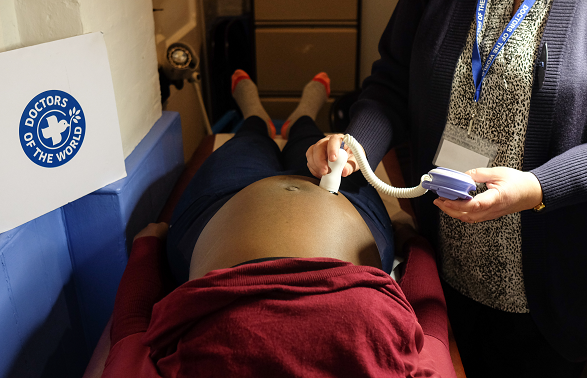
A volunteer providing antenatal care

Stories like Lilian’s bring this home. Lilian fled Vietnam to escape political persecution after she and other family members received threats. She was brought to the UK by people smugglers who took her passport. She has been living and working in a nail salon for the last four years.

Lilian came to the clinic when she was 10 weeks pregnant. She had been too scared to access healthcare before, but was experiencing abdominal pain and was worried about her baby. Our volunteers immediately sent her to A&E where she had an emergency scan and received treatment.

We continued to work with Lilian to help her to register with a GP and access antenatal care. Thankfully, the story has a happy ending and she gave birth to a healthy baby boy.

Equality matters. Everyone at Doctors of the World will continue to fight against healthcare injustices, to help vulnerable women like Lilian.

As well as highlighting inequality, today is also a good chance to celebrate our wonderful volunteers and say ‘thank you’ for their contribution.

From 70 year-old Johanna on her 70th Doctors of the World mission in Cambodia, to our student volunteers helping answer calls on her helpline, Doctors of the World is reliant on good people willing to give their time to help others.

Until Mother’s Day on Sunday, we’ll be sharing stories about female medical pioneers, Doctors of the World staff and volunteers and issues around women’s health on Facebook and Twitter.

SHELLING PREVENTS AID FROM ENTERING EASTERN GHOUTA, SYRIA

Published 2nd March 2018

Ferocious bombing and airstrikes since Saturday’s vote have prevented life-saving humanitarian aid into Eastern Ghouta. According to the United Nations, inter-agency aid convoys are ready to go to ten besieged and hard-to-reach locations. They include a 45-truck convoy with aid for 90,000 people to Douma in eastern Ghouta. The bombing and fighting is preventing these convoys from delivering life-saving aid.


“The unwillingness of permanent members of the UN Security Council to use their influence to ensure the implementation of this cessation of hostilities is shameful,” said David Miliband, President and CEO of the International Rescue Committee. “Unless the Security Council’s demands are swiftly translated into action, Eastern Ghouta will remain hell on earth for hundreds of thousands of civilians.”

UN Security Council Resolution 2401, passed on February 24, demands a “durable humanitarian pause for at least 30 consecutive days throughout Syria, to enable the safe, unimpeded and sustained delivery of humanitarian aid and services and medical evacuations of the critically sick and wounded.” The UN Emergency Relief Coordinator Mark Lowcock briefed the Security Council yesterday, saying “Has Security Council resolution 2401 been implemented? Is there a ceasefire in Syria? No. And no.”


Almost four hundred thousand people are trapped in Eastern Ghouta and facing acute hunger. Humanitarian aid deliveries into besieged Eastern Ghouta have been severely curtailed for the past years, with only one convoy reaching the area since November 2017. Some local organisations have managed to deliver some aid that was already stocked in Eastern Ghouta but those deliveries do not cover the huge needs.


“Our partners have managed to distribute 15kg of flour per family, to about 2,000 families, during the short hours of respite in fighting in the past few days. But this aid comes from pre-positioned stock and is not enough to start alleviating the huge needs. We need to be able to support our partners to get more food and other relief items to people in need,” said Wouter Schaap, CARE’s Syria director.

On Monday, Russian President Vladimir Putin ordered a daily five-hour pause in the Syrian government’s assault on Eastern Ghouta and the creation of a “humanitarian corridor” to allow civilians to leave. The International Committee of the Red Cross (ICRC) said on Tuesday that is ready to deliver life-saving aid to Ghouta but that it is “impossible” to bring in a humanitarian convoy in five hours, and residents in Eastern Ghouta have reported continued shelling since this announcement.

While UN Security Council Resolution 2401 affirms that military operations against the Islamic State, Al Qaeda and Al Nusra Front and other groups designated by the Council as terrorist groups can continue, the resolution also demands that all parties comply with their legal obligations under international law, including the protection of civilians. On Tuesday, civil groups and armed opposition groups in Ghouta wrote a letter to the UN Security Council stating they are committed to deporting designated terrorist groups out of Eastern Ghouta if a real ceasefire provides the conditions for this to happen.


“We need a real and actual cessation of hostilities to allow aid to reach civilians and provide hope for a more durable solution,” said Susannah Sirkin, Director of International Policy and Partnerships at Physicians for Human Rights. “Resolution 2401 can still save lives. For the sake of humanity, we call on Russia to use its influence to translate the Security Council’s demands into immediate action.”


  • The coalition of humanitarian and solidarity organizations consists of: CARE International; CCFD-Terre Solidaire; Independent Doctors’ Association (IDA); International Rescue Committee; Médecins du Monde (Doctors of the World); Mercy Corps; Physicians for Human Rights (PHR); and Union of Medical Care and Relief Organizations (UOSSM).

NHS Digital and DHSC refuse to suspend migrant data-sharing agreement with the Home Office, despite concerns raised by MPs and doctors

Published 28th February 2018

In a joint letter with the Home Office to the Health Select Committee (HSC), Department of Health and Social Care (DHSC) said “we do not consider that, on the present state of the evidence, there is warrant for a significant change of approach – or specifically for terminating” the Memorandum of Understating (MoU) which allows NHS Digital (NHSD) to share patient information, including home address, with the Home Office. This conclusion was echoed in a letter from NHSD which described the evidence that the data-sharing deterred undocumented migrants from seeking healthcare as “anecdotal”.

In light of the responses received, the HSC has decided to hold a further evidence session.

Impact on migrant health seeking behaviour and public health

Last month, the HSC called on NHSD to immediately suspend the MoU after hearing evidence from doctors and patient groups that the data-sharing arrangement made undocumented migrants too afraid to access healthcare services. The HSC accused NHSD of “comprehensively” ignoring the advice of Public Health England, as well as concerns raised by the General Medical Council and the National Data Guardian.

Lucy Jones, Director of Programmes at Doctors of the World UK, said: “In our clinic we see the devastating impact of the policy of using NHS patient records to track down and arrest migrants on a daily basis. Only this morning our clinic team met urgently about the increase in vulnerable pregnant women too frightened to go to antenatal care appointments. Whilst patient information is being shared, we cannot reassure them confidentiality will be respected.

Our doctors, nurses and patient groups have, on many occasions, provided evidence of the life or death impact of this arrangement.  The Health Select Committee and the National Data Guardian found the impact on vulnerable people living in the UK – including victims of trafficking and pregnant women to be compelling and significant yet NHS Digital is continuing to ignore them.”

Impact on patient confidentiality

The response from DHSC, the Home Office and NHSD fails to address the HSC’s concern that the agreement breaches the General Medical Council’s guidance on confidentiality and the NHS Confidentiality Code of Practice.

Acknowledging the breach, NHSD referred to an NHS England review of the NHS Code “which may result in greater alignment of the [NHS] Code of Practice with the [legal bases for the MoU].”

The HSC Chair, Dr Sarah Wollaston MP, had expressed concern about efforts to amend medical confidentiality guidance. Following the inquiry, Wollaston tweeted: “Really was not for @NHSDigital to in effect rewrite the principles underpinning confidentiality.”

Jones said: “It is deeply concerning that NHS Digital and DHSC are not listening to these concerns and will continue to breach patient confidentiality despite the Health Select Committee call to stop immediately. With doctors and nurses we’ll continue our #StopSharing campaign to call on NHS Digital to protect the principles of a confidential health service.”

Media enquiries to Ella Abraham (eabraham@doctorsoftheworld.org.uk)

Call for case studies on problems accessing NHS care for migrants

Published 19th February 2018

Recent changes to health policy, like the sharing of NHS data with the Home Office and upfront charging, have made it much more difficult for many migrants to access the healthcare they need. Like other healthcare providers working with vulnerable groups, we see the impact of these policies on our patients’ lives every day.

In order to convince policymakers of the devastating consequences of these changes, we continually collect evidence from our clinic.

Now, we’re reaching out with a call to other healthcare providers and frontline services to contribute to this evidence base. If you have seen any impact on the health, wellbeing or healthcare access of your patients as a result of the recent policy changes (described below), we invite you to submit an anonymous patient case study through our simple online survey tool.

See our Publications page for examples of how we use the case study evidence we gather.

Sharing NHS patient information with the Home Office

An MoU published in January 2017 laid out how the NHS routinely shares non-clinical patient information (like names and addresses) with the Home Office for immigration enforcement. It means that even by giving their home address to their GP, some patients are put at risk of being deported or detained.

Research has shown that fear of being reported to the Home Office causes many of our patients, including heavily pregnant women and seriously ill people, to avoid seeking the healthcare they need.

Our #StopSharing campaign, in partnership with Liberty and the National Aids Trust, has mobilised over 5,000 people against this dodgy deal.

Last month, MPs even lent their voices. Following an inquiry, Dr Sarah Wollaston, Tory MP and Health Select Committee Chair, sent a letter to NHS Digital strongly condemning the data-sharing agreement and calling for its immediate suspension.

Upfront charging in hospitals and community health services

The National Health Service (Charges to Overseas Visitors) (Amendment) Regulations 2017 came into force in October 2017 and legally require for the first time that:

  • community services receiving NHS funding –including charities– check every patient’s eligibility for free care before they receive healthcare;
  • all hospitals and NHS-funded community services charge those not eligible for free care up-front, meaning those who cannot pay will have treatment withheld unless it is classified as urgent or immediately necessary.

For more information about service and group exemptions from these charges, click here.

Our response to a recent Department of Health review into these new regulations explains the impacts we’ve seen so far and is a good example of how we use case study evidence.

To submit an anonymous patient case study to help challenge these dangerous policies, click here

Five reasons you’ll love the London to Paris Cycle

Published 25th January 2018

Places are filling up fast for our London to Paris cycle in July. Here are five reasons you won’t want to miss out. Sign up today and join the Doctors of the World team.

  1. Over the five days, you’ll make new friends, have plenty of laughs and enjoy the camaraderie of completing the 350 mile route together.
  2. Going at a your own pace (it is not a race!) you’ll be able to soak in the beautiful Kent and French countryside.
  3. A well-earned glass of Bordeaux (or refreshment of choice) and some delicious French food to recuperate on an evening.
  4. An excuse to update your cycling equipment and clothing and you could even treat yourself to a new bike!
  5. Arrive in Paris in time for the finale of the 2018 Tour de France. Watch the action live on the Champs Elysees or sneak off to the shops for a well earned treat! Hermes macarons are to die for…

Whatever your reason for signing up, register today so you don’t lose your spot. It only takes two minutes.

You’ll have an amazing time! Just imagine the warm glow and satisfaction you’ll get when you arrive in Paris and see the Eiffel Tower.

To reserve your place we ask for a registration fee of £125.

All riders are encouraged to raise funds for the work of Doctors of the World. The target is £1650 – around £5 per mile cycled!

Want to know more? Get in touch with Pete on 020 7167 5789 or email paldridge@doctorsoftheworld.org.uk

Event details (read our event page for full details):

London to Paris cycle

Start: 25 July 2018, London

Finish: 29 July 2018, Paris before you get the Eurostar back to London

A challenging, but relaxed 350 mile cycle through the Kent and French countryside.

MPs and doctors challenge Home Office access to NHS patient data

Published 23rd January 2018

Semira from Eritrea had been living in the UK for several years, kept captive in modern day slavery.

When she finally managed to escape, she didn’t know where to turn. She was too frightened of the potential consequences of making herself known to any services, including her local GP, so she came to Doctors of the World UK for help.

We want to reassure patients like Semira that it’s safe to go to a GP and access the basic healthcare they’re legally entitled to. But since we found out that NHS Digital had agreed to share thousands of patients’ private information with the Home Office, we haven’t been able to do that. The reality is that if Semira gives her address and her GP saves it on her medical record, the Home Office can access it. She may be tracked down, detained and deported as a result.

Last year, our #StopSharing campaign, supported by doctors and nurses across the country in partnership with the National Aids Trust, called on the Government to end this toxic deal. We also asked the parliamentary Health Select Committee to hold an inquiry. We’re delighted they agreed it needed scrutiny and went ahead with an evidence session last week. They heard from our GP, Dr Lu Hiam, who told them about the experiences of our patients like Semira, who are too scared to see their doctor, even when seriously ill or heavily pregnant. Lu told the Committee:

“Just this morning someone who was eight weeks pregnant was on the phone to us in tears, saying she was too scared to go to a GP, she was too scared to go to an antenatal clinic.

“And in one extreme circumstance we had a woman present to us in labour.”

The evidence session is the first time the deal has received any real scrutiny, or that the impact on people’s lives and health has been properly looked at. The Committee is a cross-party panel of MPs chaired by Dr Sarah Wollaston, a Conservative GP, and includes many doctors. They had the same reaction to the deal that any doctor we’ve talked to: concern and disbelief.

Dr Paul Williams, a Labour MP and a GP in Stockton, came out strongly against the ongoing breaches in patient confidentiality:

“Patients should give information to health services safe in the knowledge that it will be protected.

“We’ve seen today that this confidentiality is being breached on an industrial scale.

“Doctors don’t want to see this happening, and we’ve heard heartbreaking stories today of harm being done to patients.”

We welcomed the opportunity to shed light on such a critical issue for some of our most marginalised patients. The evidence session showed that doctors and nurses have a voice and the ability to challenge damaging Government policies which threaten everyone’s right to healthcare.

We’ll keep on working with healthcare professionals in Government and across the country to fight for a safe and confidential NHS. For now, along with the many #StopSharing supporters and partners, we eagerly await the Committee’s report. We hope that its recommendations will reflect the concerns we shared and tackle this nasty deal head on.

Sign the petition telling the NHS to #StopSharing private patient information for immigration enforcement.

Read the briefing from DoTW and the National Aids Trust on the data-sharing agreement Briefing_MOUwithHO_DOTW_NAT_2017_(3).

x

With your support, Doctors of the World will make sure nobody suffers or dies due to lack of access to healthcare.